

- Tether has signed a memorandum of understanding (MoU) with Dubai Multi Commodities Centre (DMCC) to explore blockchain adoption, tokenization projects, and digital asset education.
- The agreement focuses on pilot programs, tokenized assets, digital payments infrastructure, advisory services, and industry training initiatives.
- DMCC’s ecosystem includes more than 26,000 companies, providing Tether with access to one of the Middle East’s largest business networks.
- The partnership reflects Dubai’s broader push to position itself as a hub for blockchain, tokenized finance, and regulated digital asset activity.
- The move comes as Tether expands beyond stablecoins into tokenized commodities, payments infrastructure, artificial intelligence, robotics investments, and Tether Georgian Lari stablecoin Launch initiatives.
Tether Partners With DMCC in Dubai
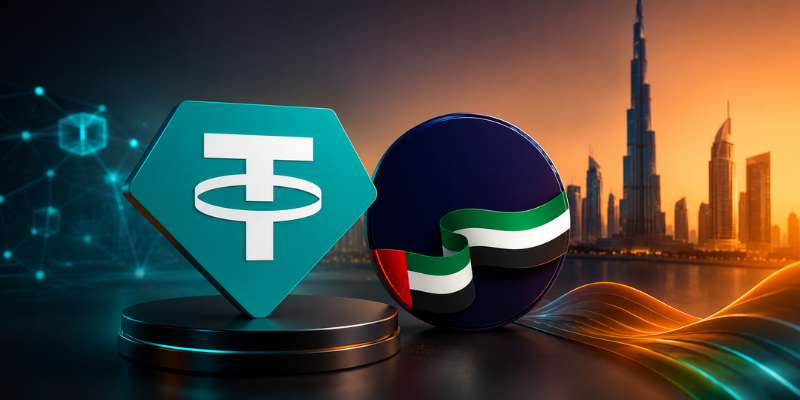
Tether, the issuer of the world’s largest stablecoin, has entered into a strategic memorandum of understanding with Dubai Multi Commodities Centre (DMCC), marking another step in Dubai’s efforts to integrate blockchain technology into mainstream business and trade operations.
The agreement establishes a framework for cooperation between the two organizations on blockchain infrastructure, tokenization initiatives, digital payments, and education programs aimed at businesses operating within the DMCC ecosystem.
DMCC, one of Dubai’s largest international business districts, hosts more than 26,000 member companies and accounts for a significant share of the emirate’s foreign direct investment activity. Through the partnership, Tether will explore ways to support businesses with advisory services, pilot projects, workshops, and practical applications of tokenized assets.
Tether Signs MoU with Dubai Multi Commodities Centre to Advance Blockchain Education, Tokenization and Innovation in Dubai
Learn more: https://t.co/NMnGMDIMKb— Tether (@tether) June 16, 2026
Tether announced the agreement on June 16, stating that the collaboration will focus on blockchain education, tokenization initiatives, and broader digital asset innovation within Dubai’s business ecosystem.
Partnership Scope Focuses on Infrastructure and Adoption
According to details released by both organizations, the collaboration will examine several areas where blockchain technology could be applied in commercial environments.
Key areas under consideration include:
- Tokenization of real-world and financial assets
- Blockchain-based payment infrastructure
- Digital asset settlement systems
- Industry education and workforce development
- Pilot programs for enterprise blockchain applications
- Hackathons and innovation-focused events
The agreement also outlines plans to assess peer-to-peer communication and payment systems that could potentially serve businesses operating within DMCC’s network. While no specific products or commercial deployments have been announced, the MoU creates a pathway for future collaboration and testing of blockchain-based financial infrastructure.
Why Dubai Matters for Digital Asset Firms
Dubai has emerged as one of the most active jurisdictions globally for digital asset companies. Over the past several years, authorities have introduced regulatory frameworks aimed at attracting blockchain businesses while providing legal clarity for virtual asset activities.
The city’s strategy differs from many financial centers that have taken a more cautious approach toward cryptocurrency-related businesses. Instead, Dubai has focused on building specialized ecosystems, including DMCC’s Crypto Centre, to attract startups, exchanges, infrastructure providers, and institutional participants.
Industry observers note that tokenization has become a growing area of interest among governments and financial institutions. The technology allows ownership rights linked to real-world assets, including commodities, real estate, and financial instruments, to be represented digitally on blockchain networks. Supporters argue that tokenization could improve settlement speed, transparency, and accessibility, although large-scale adoption remains in its early stages.
Tether’s Expansion Beyond Stablecoins
The DMCC partnership arrives during a period of diversification for Tether. Traditionally known for issuing USDT, the company has increasingly expanded into adjacent sectors, including tokenized commodities, payments infrastructure, artificial intelligence, and robotics.
Recent initiatives include:
- A tokenized gold payments program developed with fintech partner Fasset
- Investment participation in German robotics company Neura Robotics
- Continued expansion of blockchain education and infrastructure projects across multiple regions
In addition, evolving global compliance discussions such as Tether USDT MiCA regulation in the European Union highlight how stablecoin issuers are increasingly navigating stricter regulatory frameworks while expanding internationally. These moves suggest Tether is seeking to broaden its role beyond stablecoin issuance and position itself as a wider digital infrastructure provider.
What Comes Next
The memorandum does not commit either party to specific investments or deployment timelines. Instead, it provides a framework for evaluating future projects and educational initiatives. For Dubai, the collaboration reinforces ongoing efforts to attract blockchain-focused enterprises and strengthen its position within the digital asset economy. For Tether, it offers access to a large business network that could serve as a testing ground for tokenization and blockchain-based payment applications.
Whether these initiatives translate into commercial deployments will depend on regulatory developments, enterprise demand, and the practical viability of tokenized financial infrastructure in cross-border trade and business operations.
FAQs
1. Is Tether investing money in DMCC?
No. The agreement is a memorandum of understanding focused on collaboration, education, infrastructure exploration, and tokenization initiatives rather than a direct investment or funding transaction.
2. What is DMCC?
DMCC is a Dubai-based international business district and trade hub that hosts more than 26,000 companies across commodities, technology, finance, and other sectors.
3. What does tokenization mean?
Tokenization is the process of representing ownership of real-world or financial assets as digital tokens on a blockchain, enabling easier transfer, settlement, and management.
4. Why is this partnership significant?
The agreement highlights growing institutional interest in blockchain infrastructure and reflects Dubai’s strategy to become a global center for digital assets, tokenized finance, and emerging financial technologies.
Disclaimer: Cryip's content is strictly for educational and informational purposes and does not constitute financial, legal, or investment advice. Cryptocurrency involves significant risk, and readers assume full responsibility for their own financial decisions. Asset references are never endorsements.
To make complex crypto topics accessible to readers at all experience levels, our team uses AI tools strictly to refine language, correct grammar, and simplify terminology. AI is never used to draft facts, source information, or form conclusions. Every article is fact-checked and approved by a human editor before publication. Read our full AI Use & Content Policy.