




- Revolut launched EURR, its first euro-backed stablecoin, on August 26, 2026, starting with eligible customers in Denmark, Poland and Portugal.
- The token is issued by Bridge Building S.A., the Luxembourg arm of Stripe-owned Bridge, which was added to the EU’s MiCA authorized-issuer register on August 7, just 19 days before launch.
- The ticker EURR was already in use. A Malta-licensed euro stablecoin from StablR, backed in part by Tether, carries the same symbol and depegged 26% after a $13.5 million StablR Euro exploit in May.
Revolut launched EURR, its first euro-backed stablecoin, on Wednesday, giving eligible customers in Denmark, Poland and Portugal a way to move euros onto a blockchain rail without leaving the app. The company said on its official account that EURR is designed to hold a value of one euro and is backed by reserves managed by an EU-licensed issuer, with more currency-pegged tokens already in development.
We’re rolling out EURR, our first euro-backed stablecoin, in the Revolut app. pic.twitter.com/UVcns1mytF
— Revolut (@Revolut) August 26, 2026
Bridge Secures MiCA Approval Ahead of EURR Launch
The issuer is Bridge Building S.A., the Luxembourg entity behind Stripe-owned Bridge. Bridge only secured its MiCA and EMI authorizations covering the EU on August 7, becoming the 42nd company on the bloc’s electronic-money-token register. Revolut’s own crypto arm, Revolut Digital Assets Europe, holds a separate license from Cyprus’s CySEC to offer the token to customers, and points users to its stablecoin white paper and redemption terms alongside a standard crypto-asset risk disclosure.
Revolut’s EURR Launch Faces Existing Ticker Rival
The launch lands EURR in the middle of a naming problem Revolut did not create but now has to live with. A different euro stablecoin, also ticked EURR, has traded since 2024 under Malta-based issuer StablR, a company in which Tether took an equity stake in December 2024 as part of its Hadron tokenization push.
On May 24, an attacker who compromised a single signer’s key on StablR’s minting multisig created $13.5 million in unbacked EURR and USDR tokens and dumped them on decentralized exchanges, sending EURR down to $0.85, roughly 26% below its peg, before StablR confirmed the exploit and moved to contain it.
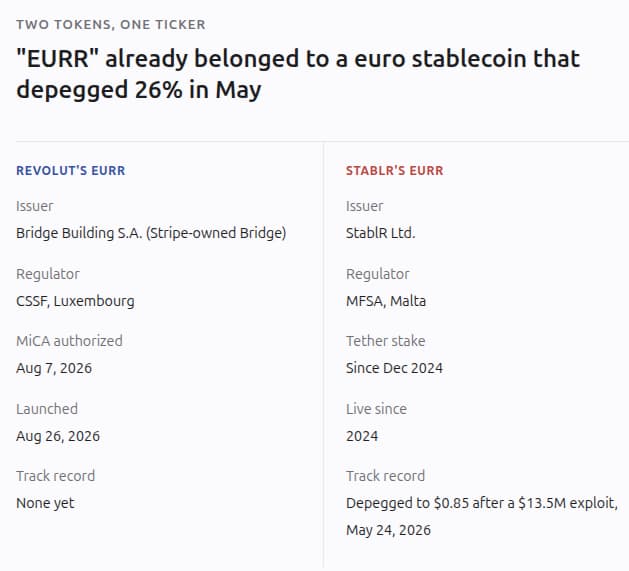
Anyone typing “EURR” into an exchange search bar or a block explorer from here on has to know which one they are looking at: a three-month-old token with a documented depeg and, per StablR’s own incident disclosure, what fixed the compromised multisig, or a 19-day-old one issued by a payments company that has never had a stablecoin exploited.
Why Revolut needed its own token now
The overlap sits inside a broader reshuffle MiCA is forcing on Revolut’s crypto shelf. The company is separately removing Tether’s USDT for European users by August 31, after Tether declined to seek MiCA authorization rather than meet the rule’s requirement, laid out on the CSSF’s own MiCA guidance, that a euro e-money token issuer hold reserves largely in European bank deposits. Revolut USDT delisting is part of the broader compliance shift, as the company adjusts its European crypto offerings to align with MiCA requirements.
ECB euro stablecoin concerns are also becoming relevant as euro-backed tokens expand across the European market, raising broader questions around monetary sovereignty, payment infrastructure and the role of private stablecoins.
StablR’s tokens, boosted by Tether’s investment, were positioned as one of the MiCA-compliant landing spots for that displaced volume, the same category EURR now enters as a competitor.
Built on Polygon already
Revolut has been building the pipes for this for over a year. It brought stablecoin remittances onto the Polygon network for UK and non-EU customers in November 2025 and had processed more than $1.2 billion in on-chain stablecoin volume there by March. EURR’s initial three-country rollout is narrow by design; Revolut said wider availability across the European Economic Area is expected later this year, alongside stablecoins pegged to other currencies.
Whether EURR outgrows its three-country pilot will depend less on Revolut’s own execution than on how the market sorts out a ticker it now shares with a token that has already had a bad month.
Disclaimer: Cryip's content is strictly for educational and informational purposes and does not constitute financial, legal, or investment advice. Cryptocurrency involves significant risk, and readers assume full responsibility for their own financial decisions. Asset references are never endorsements.
To make complex crypto topics accessible to readers at all experience levels, our team uses AI tools strictly to refine language, correct grammar, and simplify terminology. AI is never used to draft facts, source information, or form conclusions. Every article is fact-checked and approved by a human editor before publication. Read our full AI Use & Content Policy.