



- Dunamu, operator of Upbit, and Visa announced a strategic partnership on August 28 to research stablecoin payments, cross-border remittance and AI-driven “agentic commerce.”
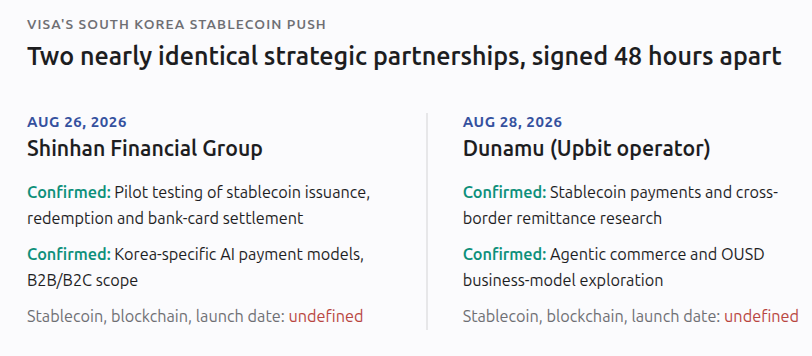
- Visa signed a strategic partnership with Shinhan Financial Group on August 26 covering nearly the same ground: stablecoin pilots, AI payment models and settlement testing.
- Neither deal names a stablecoin, blockchain, custody provider or launch date.
Dunamu and Visa said Thursday they will jointly research stablecoin payments and AI-driven commerce. Dunamu CEO Oh Kyung-seok and Visa global president Oliver Jenkins unveiled the roadmap at Visa’s Global Market Support Center in San Francisco.
Visa Expands Its Korean Stablecoin Strategy
The deal is Visa’s second strategic partnership with a major South Korean financial institution in three days. On August 26, Visa signed a similarly structured agreement with Shinhan Financial Group, South Korea’s largest banking group, to pilot stablecoin issuance and redemption, test AI-powered payment models, and expand bank-card settlement.
Shinhan chairman Jin Ok-dong said the deal would connect Shinhan’s financial capabilities with Visa’s global infrastructure to design new future finance models. Both announcements lean on the identical four-word framing, stability, transparency, interoperability and regulatory compliance, and both leave the same list of variables unresolved.
That overlap matters more than either announcement alone. A single exploratory deal is routine; two structurally identical ones, three days apart, with two of Korea’s largest financial players, look like Visa working a template across the market rather than negotiating each relationship from scratch, ahead of South Korea’s still-unfinished stablecoin legislation.
What’s Still Undecided
Dunamu said it will explore whether OUSD, the open-standard stablecoin backed by more than 140 institutions including Visa and Mastercard, could fit a future product, but a Dunamu spokesperson said the company is not prioritizing nor excluding specific stablecoins. The Dunamu Hana Bank deal also highlights how the Upbit operator is building relationships across South Korea’s traditional financial sector as it explores new digital-asset services.
Neither deal has yet specified a stablecoin, blockchain, custody arrangement or settlement process, and both remain without a launch date or named market. The Visa Nium stablecoin settlement pilot in Singapore offers a more concrete example of how Visa is testing regulated stablecoin infrastructure, with the companies exploring seven-day settlement under the Monetary Authority of Singapore’s BLOOM initiative.
The agentic-commerce piece, AI agents searching for and completing purchases on a user’s behalf, has no disclosed controls yet for authorization, spending limits or fraud prevention. The Samsung Dunamu stablecoin infrastructure effort faces a similar challenge: major financial and technology players are moving ahead with digital-asset plans while the regulatory framework remains unfinished.
Why Visa Is Moving Fast
The urgency behind the pace is easier to verify than the products themselves. Visa’s own disclosures put its stablecoin settlement volume at an annualized run rate of about $7 billion across nine blockchains as of its most recent quarterly reporting, up sharply from earlier this year. The Dunamu 4% stake acquired by Samsung affiliates also reflects growing interest from major South Korean companies in the country’s digital-asset infrastructure. Signing two Korean partnerships in the same week fits a company scaling that business as fast as it can find willing partners, before regulators or rivals set the terms first.
Disclaimer: Cryip's content is strictly for educational and informational purposes and does not constitute financial, legal, or investment advice. Cryptocurrency involves significant risk, and readers assume full responsibility for their own financial decisions. Asset references are never endorsements.
To make complex crypto topics accessible to readers at all experience levels, our team uses AI tools strictly to refine language, correct grammar, and simplify terminology. AI is never used to draft facts, source information, or form conclusions. Every article is fact-checked and approved by a human editor before publication. Read our full AI Use & Content Policy.