



- Michael Saylor confirmed Strategy did not buy Bitcoin this week, opting instead to repurchase convertible debt.
- Strategy announced plans to repurchase nearly $1.5 billion in 0% convertible senior notes due 2029 for approximately $1.38 billion in cash.
- The company continues to hold 843,738 BTC valued at about $63.87 billion, with no Bitcoin sales reported for the debt repurchase.
- The move reduces potential future shareholder dilution and strengthens the company’s balance sheet.
- Saylor indicated the pause is temporary, describing it as a step to “recharge” the company’s Bitcoin acquisition capacity.
Strategy Prioritizes Debt Repurchase Over Weekly Bitcoin Acquisition
This week we bought bonds, not bitcoin. The ₿itVac is charging. pic.twitter.com/yUpVNiNTPT
— Michael Saylor (@saylor) May 24, 2026
In a post on X, Saylor stated, “This week we bought bonds, not bitcoin. The ₿itVac is charging.”
Strategy, formerly known as MicroStrategy, temporarily paused its Bitcoin purchasing activity this week and instead allocated capital toward repurchasing outstanding convertible debt, according to Executive Chairman Michael Saylor.
The comment came as investors closely monitored the company’s next move following recent volatility in Bitcoin prices and a decline in MSTR stock. The company disclosed plans to repurchase approximately $1.5 billion in face value of its 0% convertible senior notes due in 2029 for roughly $1.38 billion in cash. Strategy said the transaction would be funded through a combination of existing cash reserves, proceeds from at-the-market equity sales, and other available capital sources.
The announcement follows recent comments from Saylor indicating that the company could potentially sell Bitcoin if necessary to support corporate financing objectives, including debt-related obligations. However, the latest disclosure showed no evidence of Bitcoin sales connected to the repurchase transaction.
Bitcoin Treasury Remains Intact Despite Temporary Buying Pause
Strategy continues to hold 843,738 BTC, making it the largest publicly traded corporate holder of Bitcoin. The Bitcoin treasury was acquired for approximately $63.87 billion at an average cost of $75,700 per BTC. At current market prices, it is valued at roughly $65 billion.
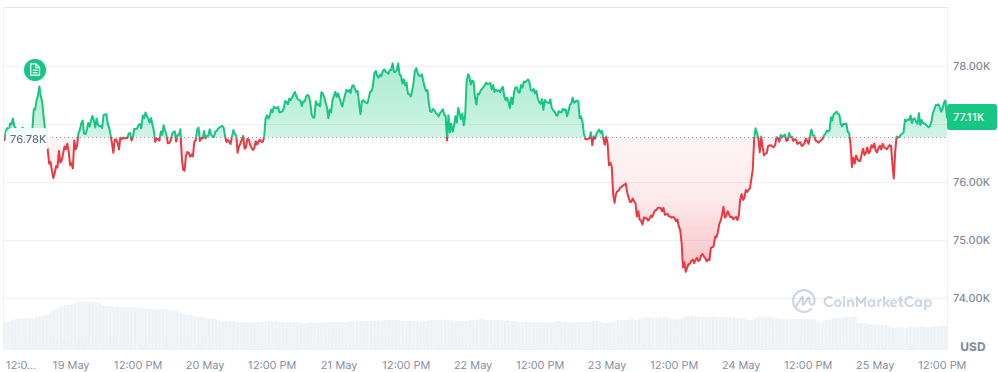
Between May 18 and May 24, 2026, Bitcoin traded in a volatile range as investors reacted to macroeconomic uncertainty and global market developments. BTC fell to a weekly low of approximately $76,700 before recovering and consolidating between $74,000 and $78,000. By May 24, Bitcoin was trading near $77,000, while its market capitalization remained around $1.54 trillion, preserving its position as the largest cryptocurrency by market value. The company recently expanded its holdings through the acquisition of 24,869 BTC, funded primarily through the sale of STRC perpetual preferred shares and MSTR common stock. That purchase totaled approximately $2.01 billion.
This marks the third pause in Strategy’s weekly Bitcoin purchasing activity in 2026. Earlier pauses were recorded during the week of April 27 through May 3 and on another occasion earlier in 2026. Despite the temporary halt, Strategy has repeatedly emphasized its long-term Bitcoin treasury strategy. Saylor’s latest comments suggested the company is preserving financial flexibility before resuming additional Bitcoin purchases.
Debt Buyback Aims to Reduce Dilution and Strengthen Capital Structure
The repurchase of convertible notes at a discount is expected to lower potential future share issuance associated with the debt instrument. By retiring the notes before maturity, Strategy reduces dilution risk for existing shareholders and potentially increases Bitcoin exposure on a per-share basis.
The transaction also improves the company’s balance sheet by reducing outstanding liabilities and lowering concerns related to leverage. Analysts and investors have closely followed Strategy’s financing structure because the company has raised substantial capital through equity offerings, convertible debt, and preferred-share issuances to support its Bitcoin acquisition strategy.
During a recent earnings call, Saylor said the company could potentially sell a portion of its Bitcoin holdings in the future to fund corporate obligations such as dividend payments if necessary. However, the latest debt repurchase announcement indicates the company remains committed to maintaining its substantial Bitcoin treasury while optimizing its capital structure. The company continues to signal that Bitcoin accumulation remains a core component of its long-term strategy, with the current pause focused on debt management rather than a shift away from digital asset holdings.
Disclaimer: Cryip's content is strictly for educational and informational purposes and does not constitute financial, legal, or investment advice. Cryptocurrency involves significant risk, and readers assume full responsibility for their own financial decisions. Asset references are never endorsements.
To make complex crypto topics accessible to readers at all experience levels, our team uses AI tools strictly to refine language, correct grammar, and simplify terminology. AI is never used to draft facts, source information, or form conclusions. Every article is fact-checked and approved by a human editor before publication. Read our full AI Use & Content Policy.