

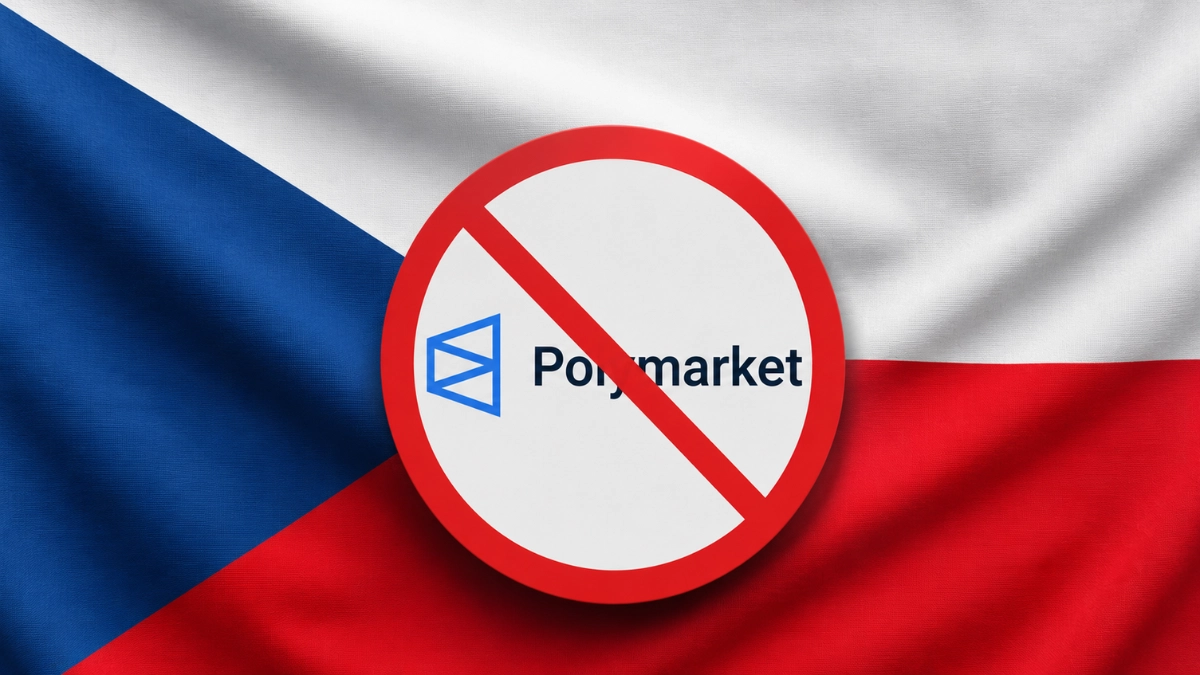


The Czech Finance Ministry added Polymarket to its list of unauthorized online gambling websites, requiring internet service providers to restrict access to the platform within 15 days. The ministry published the updated blacklist on July 13, 2026, at 2:09 p.m. local time under the Czech Gambling Act. Its official records identify polymarket.com as a website through which prohibited internet gambling is operated.
- Polymarket was added to the blacklist on July 13.
- Czech internet providers must restrict access within 15 days.
- The measure applies to access within the Czech Republic.
- Czech authorities did not identify a specific market that triggered the listing.
- The decision does not shut down Polymarket globally.
Polymarket allows users to trade contracts tied to the outcomes of elections, sports, economic developments and other future events. Czech authorities have treated the service as gambling offered without the required local authorization.
Polymarket added to unauthorized gambling list
The Finance Ministry did not issue a separate statement detailing its decision against Polymarket. The platform’s domain instead appeared in the ministry’s latest publication of unauthorized internet gambling services.
The listing shows that Czech authorities treated Polymarket as directly operating a prohibited internet game rather than merely advertising or redirecting users to another service. It remains unclear whether the company challenged the listing before it was finalized or plans to appeal.
The Czech action follows similar access restrictions in India, where Polymarket availability became inconsistent across internet providers after the platform was targeted as an unauthorized prediction-market service. Tests across Indian networks found that access varied depending on the ISP and region.
Czech ISPs given 15 days to block access
Czech internet providers must block websites placed on the unauthorized gambling list within 15 days of publication. The statutory period means restrictions on Polymarket are expected to take effect before the end of July. The measure targets access to the polymarket.com domain through Czech internet connections. It does not disable the platform’s blockchain contracts or prevent users in other jurisdictions from accessing the service.
Polymarket already operates geographic controls in several jurisdictions. Its official policy says the platform is unavailable in certain countries because of regulatory and sanctions requirements and prohibits users from using VPNs or similar tools to bypass those restrictions.
Polymarket had not publicly responded to the Czech decision at the time of publication. South Korea has taken a different enforcement approach by investigating domestic Polymarket users rather than relying only on website blocking. Police opened the country’s first such probe in June over users who allegedly traded contracts tied to local election outcomes.
Prediction markets face conflicting regulatory paths
The Czech action comes as authorities in several jurisdictions debate whether prediction markets should be regulated as gambling products, financial instruments or both. On July 3, the European Securities and Markets Authority said some event contracts may fall under existing binary-option restrictions when their structure qualifies them as financial instruments. ESMA said products should be assessed according to their economic characteristics rather than the names used to market them.
The Czech decision was made under national gambling law, while ESMA’s position concerns financial-market regulation. Prediction-market operators may therefore require gambling licences, financial authorization or both, depending on the product and jurisdiction. Polymarket is simultaneously seeking regulated expansion in markets where it currently faces access limits. The company has appointed a representative in Japan and is pursuing government authorization to introduce prediction markets in the country by 2030.
Regulatory pressure has not stopped the platform from expanding the range of events available for trading. Polymarket recently partnered with Nasdaq Private Market to introduce contracts tied to private-company valuations, IPO timelines and secondary-market activity. Those contracts use Nasdaq Private Market data to determine outcomes but do not give traders ownership in the underlying companies. The partnership illustrates how prediction markets are moving beyond elections and sports even as regulators continue debating how the products should be classified.
For Czech users, the immediate effect is a restriction on access to Polymarket’s main website. The broader issue is whether prediction-market platforms can continue expanding across international markets without obtaining authorization under local gambling and financial-services rules.
Disclaimer: Cryip's content is strictly for educational and informational purposes and does not constitute financial, legal, or investment advice. Cryptocurrency involves significant risk, and readers assume full responsibility for their own financial decisions. Asset references are never endorsements.
To make complex crypto topics accessible to readers at all experience levels, our team uses AI tools strictly to refine language, correct grammar, and simplify terminology. AI is never used to draft facts, source information, or form conclusions. Every article is fact-checked and approved by a human editor before publication. Read our full AI Use & Content Policy.