

- Trump signed Executive Orders 14409 and 14411 to advance U.S. quantum computing and cybersecurity.
- The administration aims to deploy advanced quantum computing capabilities at a U.S. national laboratory by 2028.
- Federal agencies must transition to post-quantum cryptography by 2030 for key establishment and 2031 for digital signatures.
- NIST will launch a post-quantum cryptography migration pilot within 180 days, with completion targeted by the end of 2027.
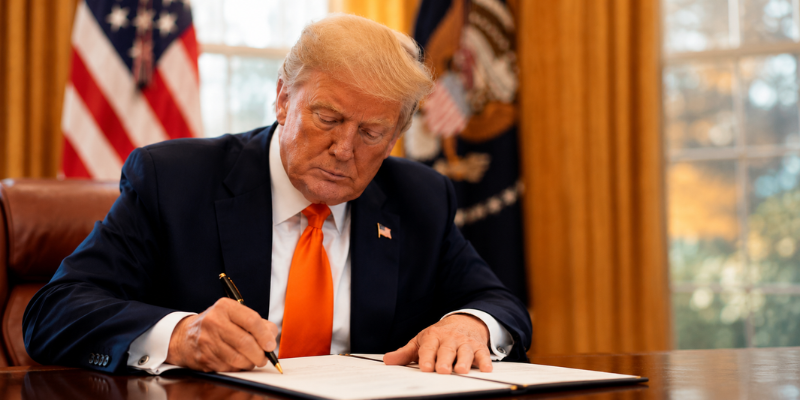
President Donald Trump has signed two executive orders aimed at accelerating the United States’ quantum computing capabilities while strengthening the nation’s defenses against future cybersecurity threats posed by advanced quantum computers.
The measures, Executive Order 14409, “Securing the Nation Against Advanced Cryptographic Attacks,” and Executive Order 14411, “Ushering In the Next Frontier of Quantum Innovation,” expand the federal government’s quantum technology strategy amid intensifying global competition in quantum research and development.
The orders focus on advancing quantum computing for scientific research, updating the national quantum strategy, and preparing federal systems for the transition to post-quantum cryptography.
White House Launches New Quantum Computing Initiative
Executive Order 14411 directs federal agencies to update the national quantum strategy and strengthen the broader quantum information science and technology ecosystem.
A key component of the order is the creation of the Quantum Computer for Application Development and Discovery Science (QC-ADDS) initiative. The program is designed to develop advanced quantum computers capable of supporting major scientific breakthroughs across multiple research fields.
The administration has set a target of deploying advanced quantum computing capabilities at a U.S. national laboratory by 2028, providing one of the clearest federal timelines for large-scale quantum computing development.
Beyond computing, the order expands federal support for quantum technologies, including quantum sensors and quantum networking systems. It also calls for strengthening domestic quantum supply chains and expanding workforce development programs to meet future industry demand.
As part of the implementation timeline, federal agencies must identify at least three next-generation quantum sensor projects within 60 days, with the goal of deploying those systems by September 30, 2028.
Federal Agencies Face Post-Quantum Cryptography Deadlines
Executive Order 14409 focuses on the long-term cybersecurity risks posed by future quantum computers, which are expected to be capable of breaking many of today’s widely used encryption standards.
To reduce that risk, the order directs federal agencies to accelerate the adoption of National Institute of Standards and Technology (NIST) approved Post-Quantum Cryptography (PQC) standards.
The administration has established firm deadlines requiring all high-value federal assets and high-impact information systems to transition to PQC for key establishment by the end of 2030 and for digital signatures by the end of 2031.
As an early milestone, the Secretary of Commerce, through NIST, must launch a post-quantum cryptography migration pilot project within 180 days. The pilot program is scheduled for completion by December 31, 2027 and is intended to help federal agencies develop implementation frameworks for broader deployment.
Preparing for the Next Era of Computing
The executive orders highlight the administration’s broader effort to ensure the United States remains competitive in quantum technology while safeguarding federal systems against emerging cryptographic threats.
By combining investments in quantum research with a nationwide transition to post-quantum cybersecurity standards, the administration aims to position the country for the next generation of scientific innovation while strengthening the resilience of critical government infrastructure.
The latest executive orders follow several recent technology and digital asset initiatives from the Trump administration. Earlier this month, Binance founder Changpeng “CZ” Zhao proposed freezing Satoshi Nakamoto’s Bitcoin as part of a future quantum security upgrade. In March, the White House cleared the way for cryptocurrency investments in 401(k) retirement plans.
Disclaimer: Cryip's content is strictly for educational and informational purposes and does not constitute financial, legal, or investment advice. Cryptocurrency involves significant risk, and readers assume full responsibility for their own financial decisions. Asset references are never endorsements.
To make complex crypto topics accessible to readers at all experience levels, our team uses AI tools strictly to refine language, correct grammar, and simplify terminology. AI is never used to draft facts, source information, or form conclusions. Every article is fact-checked and approved by a human editor before publication. Read our full AI Use & Content Policy.