




In the volatile world of cryptocurrency, price charts and hype cycles often dominate attention. Yet history shows that the most significant determinants of long-term success or failure frequently occur before a token ever lists on exchanges. Tokenomics, particularly vesting schedules and lockup mechanisms, play a pivotal role in shaping a project’s trajectory. These tools manage supply dynamics, align incentives among stakeholders, and mitigate the risks of early sell-offs that can devastate retail investors.
Without proper controls, early investors, founders, advisors, and ecosystem partners – who often hold large portions of the total supply at discounted prices – could flood the market immediately after launch. This instant dumping creates supply shocks, erodes confidence, and leads to sharp price declines. Serious blockchain projects counter this with structured vesting and lockups, fostering sustainable growth and long-term holder protection. For investors today, understanding these mechanics is non-negotiable, rivaling the importance of technology evaluation or community traction.
Defining Vesting and Lockups: Core Concepts
While the terms are frequently used interchangeably, they serve distinct yet complementary purposes:
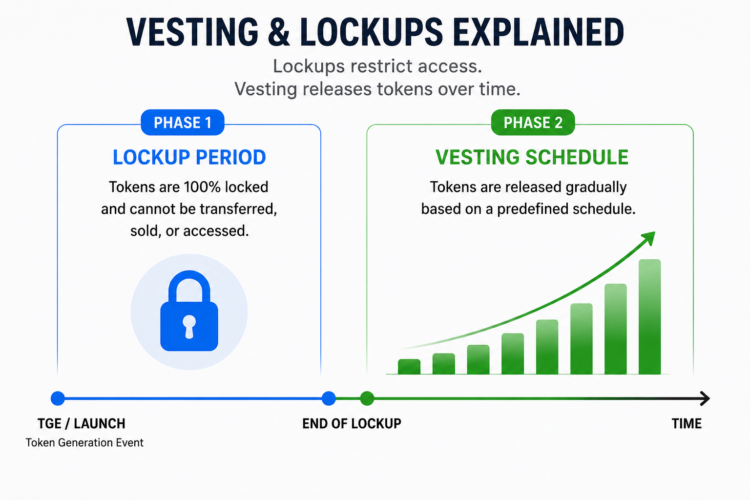
- Lockup Period: A complete restriction phase where tokens cannot be transferred, sold, or accessed. This acts as an initial firewall after launch or TGE (Token Generation Event).
- Vesting Schedule: A gradual, rule-based release of tokens over time. Recipients gain access incrementally rather than all at once, often following a lockup.
Most projects combine them. A standard team allocation might involve 15-25 percent of total supply with a 12-month cliff (no unlocks in Year 1) followed by 36-month linear vesting (equal monthly releases thereafter). This structure ensures no sudden influx, allowing the market to absorb new supply organically.
The Perils of Instant Dumping and Unlock Overhang
Early backers, especially venture capitalists, secure tokens at valuations far below public launch prices. Immediate availability incentivizes profit-taking, triggering an unlock overhang.
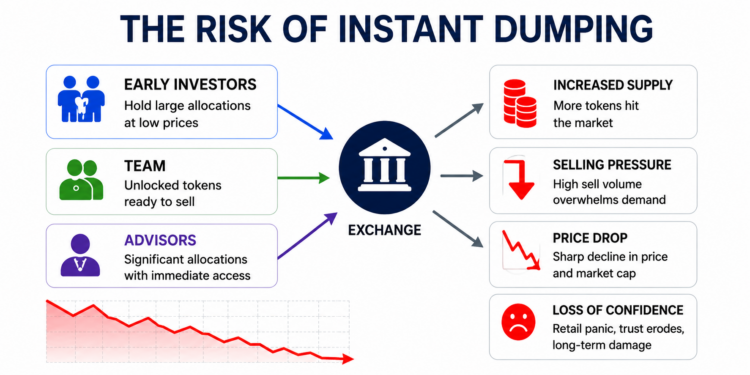
Impacts include:
- Rapid increase in circulating supply.
- Demand unable to match the new selling pressure.
- Precipitous price drops, loss of retail confidence, and reputational damage.
- Reduced project momentum despite strong fundamentals.
This pattern repeated in multiple market cycles. Large, front-loaded unlocks often correlate with prolonged underperformance, even for technically sound projects. The market attention surrounding May 2026 crypto token unlocks serves as a reminder that upcoming token releases can significantly influence investor sentiment and price action when substantial portions of supply enter circulation.
Real-World Example: Filecoin (FIL)
Filecoin, launched in October 2020 by Protocol Labs, serves as a strong positive case study of well-structured tokenomics and vesting mechanisms supporting long-term network growth in decentralized storage. Its design prioritized alignment, gradual supply introduction, and utility-driven demand, helping it navigate early challenges without the severe post-launch dumps seen in projects with weaker controls.
Token Allocation Overview
Filecoin has a hard-capped maximum supply of 2 billion FIL. At genesis, the allocation was as follows (approximate percentages of total supply):
- 70% to miners and network participants (via block rewards and mining incentives) – the largest share to reward actual storage provision and network security.
- 10.5% to Protocol Labs (core development team and entity).
- 4.5% to Protocol Labs team members and contributors.
- 7.5% to 2017 SAFT (Simple Agreement for Future Tokens) investors.
- 5% to the Filecoin Foundation (for ecosystem development and governance).
- 2.5% reserved for future fundraising or ecosystem growth.
This distribution avoided excessive centralization while reserving the majority for those actively contributing to the network’s utility.
Vesting and Lockup Schedules
Filecoin combined extended lockups, cliffs, and linear vesting tailored to stakeholder roles:
- Protocol Labs and Filecoin Foundation (15% total): 6-year linear vesting schedules with a 6-month initial cliff. This ensured core builders had long-term skin in the game.
- Protocol Labs Team & Contributors (4.5%): Also on 6-year vesting with a 6-month cliff, followed by linear releases.
- SAFT Investors (7.5%): Shorter but still meaningful terms linear vesting over 6 months, 12 months, 24 months, or 36 months depending on the investment round. This reflected their earlier risk but prevented immediate flooding.
- Mining Rewards: Subject to a 180-day linear vesting period for most block rewards (with 25% immediately available in some adjustments for miner cash flow). Mining rewards themselves follow baseline and simple minting curves, with simple minting on a 6-year half-life schedule (most emission front-loaded but tapering significantly).
These schedules were encoded in smart contracts and transparent from the start, verifiable on-chain and in official documentation.
Impact on Project Trajectory
The extended vesting periods helped Filecoin avoid the classic “unlock overhang” trap. Early circulating supply was limited, allowing the market to absorb new tokens as the network demonstrated real utility (storage deals, proven capacity growth, and adoption). While the project faced volatility and technical hurdles in its early years, the controlled supply dynamics supported resilience:
- Gradual releases aligned incentives for sustained development rather than short-term exits.
- Miner vesting encouraged reliable long-term storage provision.
- The design paired supply management with genuine demand drivers (paying for decentralized storage with FIL).
As of recent data, Filecoin has matured into a leader in decentralized storage without the catastrophic early dilution that plagued hype-driven launches. Its circulating supply has grown predictably alongside network usage, with mechanisms like token burns (from fees) providing some deflationary pressure.
Key Lessons from Filecoin
- Long Horizons Work: Multi-year vesting (especially 3–6 years for insiders) signals serious commitment and reduces sell pressure.
- Utility-First Design: Vesting succeeded because it was paired with a clear use case (storage payments) that creates organic demand to offset unlocks.
- Transparency Builds Trust: Public, on-chain schedules and detailed documentation allowed investors to model future supply accurately.
- Balanced Release Curves: Combining cliffs, linear vesting, and performance-tied mining rewards created predictability without stifling growth.
In contrast to projects with short cliffs and large front-loaded unlocks, Filecoin’s approach demonstrated how thoughtful tokenomics can support fundamental progress through market cycles. Investors evaluating new projects can use Filecoin as a benchmark: look for similar alignment between supply schedules, stakeholder incentives, and verifiable utility.
The Fundamental Purposes of Vesting Mechanisms
Vesting transcends simple restriction. It functions as an incentive-alignment framework with several key benefits:
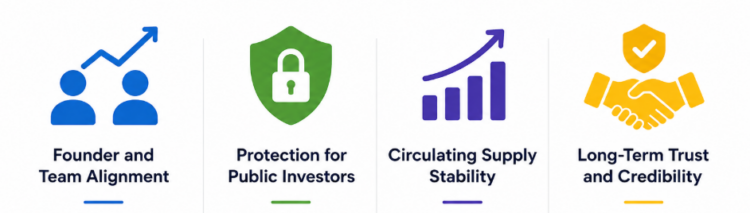
- Founder and Team Alignment: Multi-year schedules ensure builders remain motivated. Immediate full access might encourage short-term exits over sustained development.
- Protection for Public Investors: Retail participants feel more secure knowing insiders cannot dump en masse shortly after launch.
- Circulating Supply Stability: Gradual releases enable markets to digest new tokens without volatility spikes.
- Long-Term Trust and Credibility: Transparent schedules signal commitment to sustainable growth rather than quick flips.
Types of Vesting Schedules: Strengths and Trade-offs
Not all models perform equally. Key variants include:
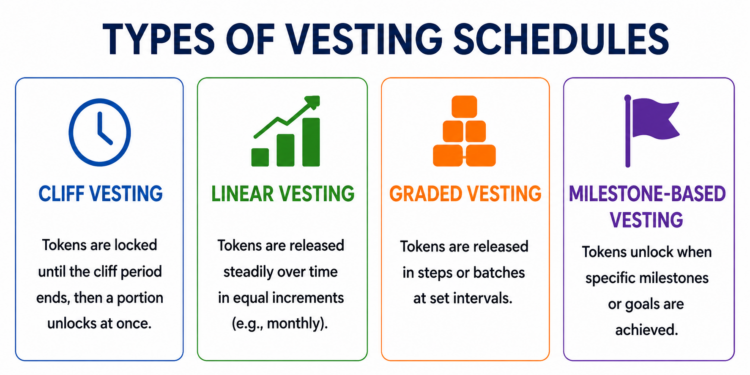
- Cliff Vesting: Tokens remain locked until a set period ends (for example, 12 months), then a portion unlocks. This approach excels at signaling commitment, especially for founders.
- Linear Vesting: Steady, predictable releases (for example, 1/36th monthly after the cliff). This model is favored for its market-friendliness and reduced surprise.
- Graded or Step Vesting: Batched releases, such as 25 percent annually over 4 years. It introduces controlled liquidity while retaining incentives.
- Milestone-Based or Hybrid: Unlocks tied to achievements like mainnet launch, TVL milestones, user growth, or governance activation. This directly links rewards to performance, though it is harder to administer.
Hybrid models that combine time-based with performance elements often yield the best results by adapting to actual project progress.
Stakeholder Allocations and Tailored Schedules
Vesting terms vary by group to match their roles and risks:
- Founders and Core Team: Longest horizons (1-year cliff plus 3-5 years vesting) to demonstrate skin in the game.
- VC Investors: Typically 6-12 month lockups plus 2-4 year vesting, reflecting their discounted entry points.
- Advisors: Moderate terms to encourage ongoing contributions.
- Ecosystem Funds and Community: More flexible. Airdrop or mining rewards may have shorter cliffs to drive adoption, while grants vest based on usage.
Balanced distribution prevents excessive centralization risks that could undermine governance.
FDV versus Circulating Market Cap: A Critical Lens
Retail investors often fixate on market capitalization. Sophisticated analysis prioritizes Fully Diluted Valuation (FDV) – the hypothetical value if all tokens were circulating at current prices.
| Metric | High-Risk Project (A) | Healthier Project (B) |
| Circulating Supply | 100M tokens | 100M tokens |
| Total Supply | 1B tokens | 250M tokens |
| Percent Unlocked | ~10 percent | ~70-80 percent |
| FDV / Circ. MC Ratio | Very High (heavy overhang) | Moderate (limited dilution) |
| Long-Term Pressure | Prolonged selling risk | More stable dynamics |
Hallmarks of Excellent Tokenomics
Strong designs balance multiple factors for optimal outcomes:
- Extended Founder Commitment: At least 3 years with meaningful cliffs.
- Predictable, Linear Releases: These minimize shock events compared to large periodic unlocks.
- Radical Transparency: Schedules should appear in whitepapers, on-chain contracts, governance documents, and public dashboards.
- Reasonable Insider Allocation: Avoid majority control that raises centralization flags.
- Genuine Utility: Features such as staking, governance, transaction fees, or token burns create organic demand to offset new supply from unlocks.
Projects like Bitcoin with its capped supply and halvings, or Ethereum with dynamic issuance tied to network utility, exemplify enduring models. Newer projects adapt these principles to their specific ecosystems.
Red Flags and Warning Signs
Investors should scrutinize the following closely:
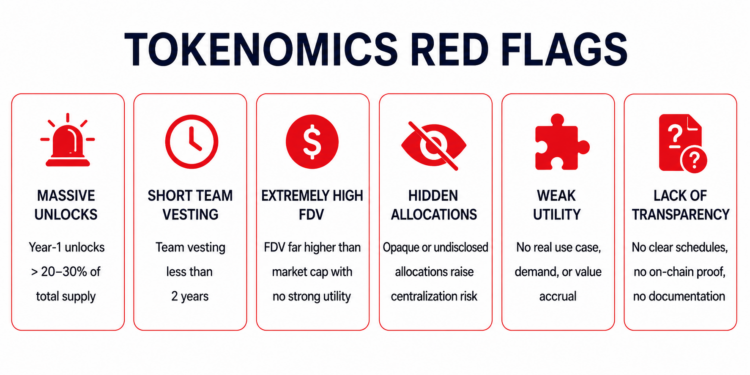
- Massive Year-1 unlocks exceeding 20-30 percent of supply.
- Opaque or hidden allocations that lack clear documentation.
- Team vesting shorter than 2 years.
- Extremely high FDV relative to current market cap without strong justification.
- Lack of documented schedules or verifiable smart contracts on blockchain explorers.
These issues do not automatically doom a project but warrant deeper due diligence and possibly avoidance until clarified.
Evolving Importance in Mature Markets
Lessons from the 2021-2022 cycle, combined with growing institutional participation, have raised standards across the industry. Markets now penalize poor tokenomics more severely than before. Projects featuring robust schedules attract patient capital from sophisticated investors. Hype-driven launches with weak structures tend to falter during unlock cycles. Additional features such as utility-driven demand, deflationary mechanisms like burns, and adaptive governance further strengthen resilience against supply pressures.
Conclusion
Vesting and lockups form the bedrock of credible tokenomics. They convert potential chaos into managed, predictable growth by aligning founders with users, curbing destructive dumps, stabilizing supply, and cultivating ecosystem trust. No amount of innovative technology can fully compensate for flawed economics. However, sound vesting structures can amplify strong fundamentals and support healthier market dynamics over time.
Before committing capital to any investment, probe deeply into the details: Who holds the major token allocations? When and how much can they sell? Does the overall schedule support genuine utility and a credible long-term vision? Following tokenomics vesting updates can provide valuable insight into future supply dynamics and potential selling pressure. In crypto, sustainable success often hinges on thoughtfully answering these questions rather than chasing short-term price action alone.
FAQs
1. What is token vesting in crypto?
A structured, time-based or milestone-based release of tokens to insiders and contributors. It prevents sudden supply floods and aligns incentives for long-term success.
2. Lockup versus Vesting?
A lockup imposes total restrictions for a defined period. Vesting governs the subsequent gradual release of tokens according to predefined rules.
3. Do unlocks always cause price drops?
Not necessarily. Impact depends on unlock size as a percentage of supply, prevailing market conditions, recipient behavior, and the strength of underlying demand. Expected, smaller unlocks in projects with high utility often produce minimal negative effects.
4. What constitutes a healthy vesting schedule?
Common benchmarks include a 1-year cliff followed by 3-4 years of linear or graded vesting for core teams. Full transparency and clear linkage to utility or performance milestones rank among the most positive indicators.
5. How to research a project’s schedule?
Review official documentation such as whitepapers and governance proposals. Verify smart contracts on blockchain explorers. Use specialized trackers like Tokenomist or DefiLlama. Finally, analyze FDV dynamics relative to circulating supply and market conditions.
Disclaimer: Cryip's content is strictly for educational and informational purposes and does not constitute financial, legal, or investment advice. Cryptocurrency involves significant risk, and readers assume full responsibility for their own financial decisions. Asset references are never endorsements.
To make complex crypto topics accessible to readers at all experience levels, our team uses AI tools strictly to refine language, correct grammar, and simplify terminology. AI is never used to draft facts, source information, or form conclusions. Every article is fact-checked and approved by a human editor before publication. Read our full AI Use & Content Policy.