

Tokenomics, a blend of “token” and “economics,” represents the comprehensive economic framework that governs the creation, distribution, circulation, utility, and incentive structures of a cryptocurrency token or blockchain-based project. It is the foundational design that determines how value is created, captured, and sustained within a decentralized ecosystem. Unlike traditional financial instruments backed by corporate balance sheets or cash flows, crypto tokens derive their worth from protocol-level mechanics encoded in smart contracts, on-chain governance, and network participation.
In essence, tokenomics serves as both the constitution and the operating system of a crypto project. It dictates token supply dynamics, allocation strategies, demand drivers, and behavioral incentives that encourage users, developers, validators, and investors to contribute to the network’s growth. A well-architected tokenomics model can bootstrap network effects, secure the blockchain, and align stakeholder interests for long-term sustainability. Conversely, flawed designs often lead to hyperinflation, speculative bubbles, premature dilution, or total collapse.
As of 2026, with the crypto market maturing amid regulatory scrutiny and institutional adoption, tokenomics has evolved from a buzzword into a critical evaluation criterion. Investors, builders, and users who master it gain a significant edge in identifying projects with genuine staying power.
The Evolution and Fundamentals of Tokenomics
The concept gained prominence with Bitcoin’s 2009 launch, which introduced a fixed supply cap of 21 million coins and a predictable issuance schedule via halvings. This scarcity-driven model proved that thoughtfully designed economics could create a credible digital store of value without central authority. Ethereum later expanded the playbook by enabling programmable money, smart contracts, and diverse token standards (ERC-20, ERC-721), allowing projects to experiment with utility, governance, and yield mechanisms.
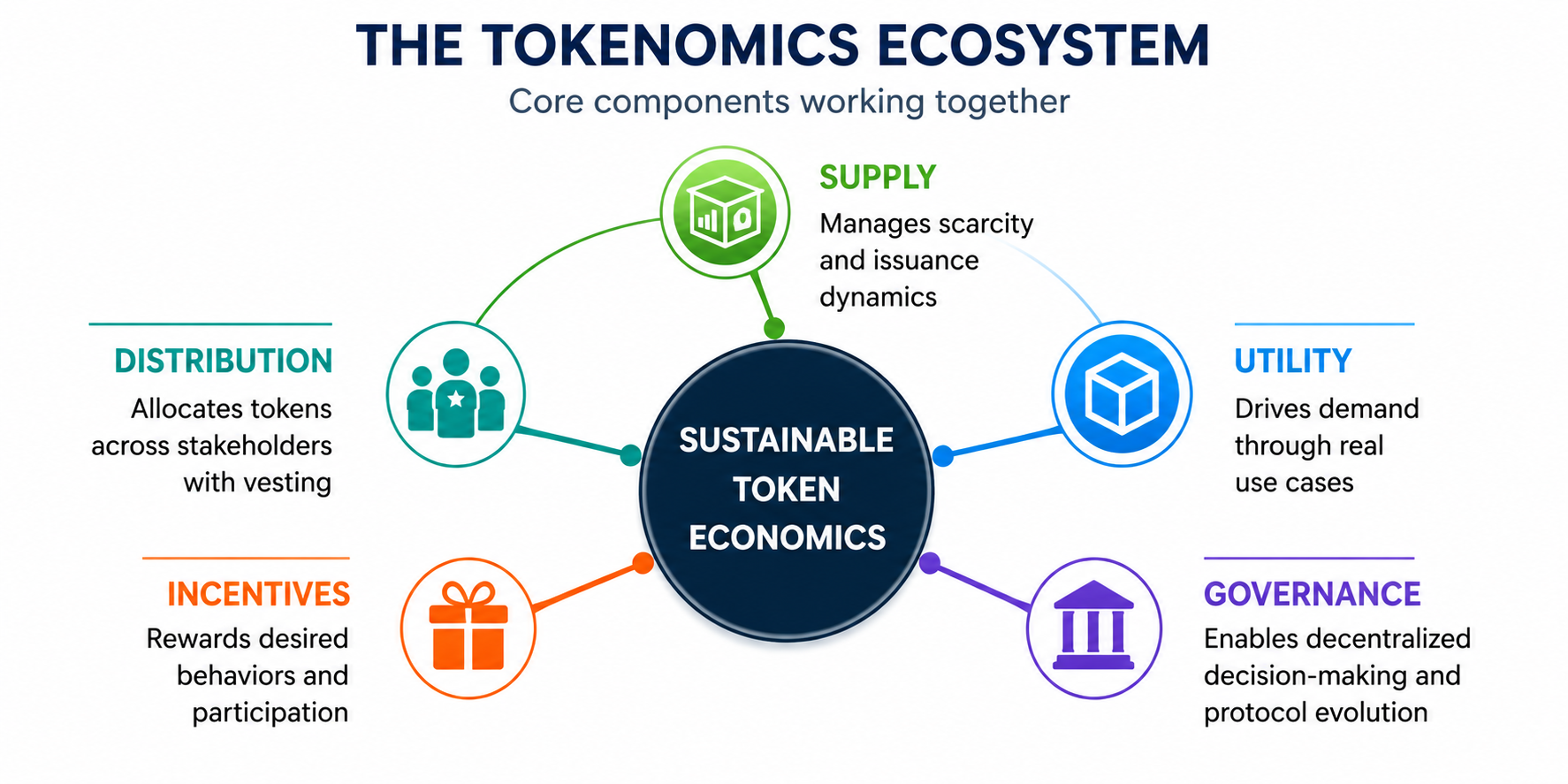
Today, tokenomics encompasses several interdependent elements. At its core are supply mechanics, distribution and vesting, utility and demand generation, incentive alignments, and governance structures. These components must work in harmony; a strong supply model fails without utility, while generous incentives become unsustainable without revenue capture.
1. Token Supply Models: Scarcity, Inflation, and Dynamics
Supply is the bedrock of token value perception. Key distinctions include:
- Maximum Supply: A hard ceiling (Bitcoin’s 21M, many new layer-1s). This creates predictable scarcity, often driving long-term appreciation narratives.
- Circulating Supply: Tokens actively tradable. Low circulating supply at launch with high FDV (Fully Diluted Valuation) can mask overvaluation risks.
- Inflationary vs. Deflationary: Purely inflationary models issue new tokens for rewards, potentially diluting holders unless offset by demand. Deflationary mechanisms, such as transaction fee burns (Ethereum’s EIP-1559) or buy-and-burn from protocol revenue, reduce supply over time.
- Dynamic/Algorithmic Supply: Some protocols adjust issuance based on usage, staking rates, or oracle inputs to maintain equilibrium.
Real utility examples include protocols that burn tokens proportional to activity, creating a flywheel: higher usage → more burns → reduced supply → potential price support → more users. However, supply alone is insufficient. A token with aggressive deflation but zero usage will still trend toward zero. Builders must model supply curves against projected adoption using tools like spreadsheets or economic simulators.
Investors should calculate FDV-to-circulating market cap ratios. A project with $1B FDV and only 10% circulating supply signals substantial future dilution pressure from unlocks.
2. Distribution and Allocation Strategies
How tokens are initially distributed reveals much about a project’s fairness and decentralization ambitions. Typical breakdowns (visible in whitepapers or Dune dashboards):
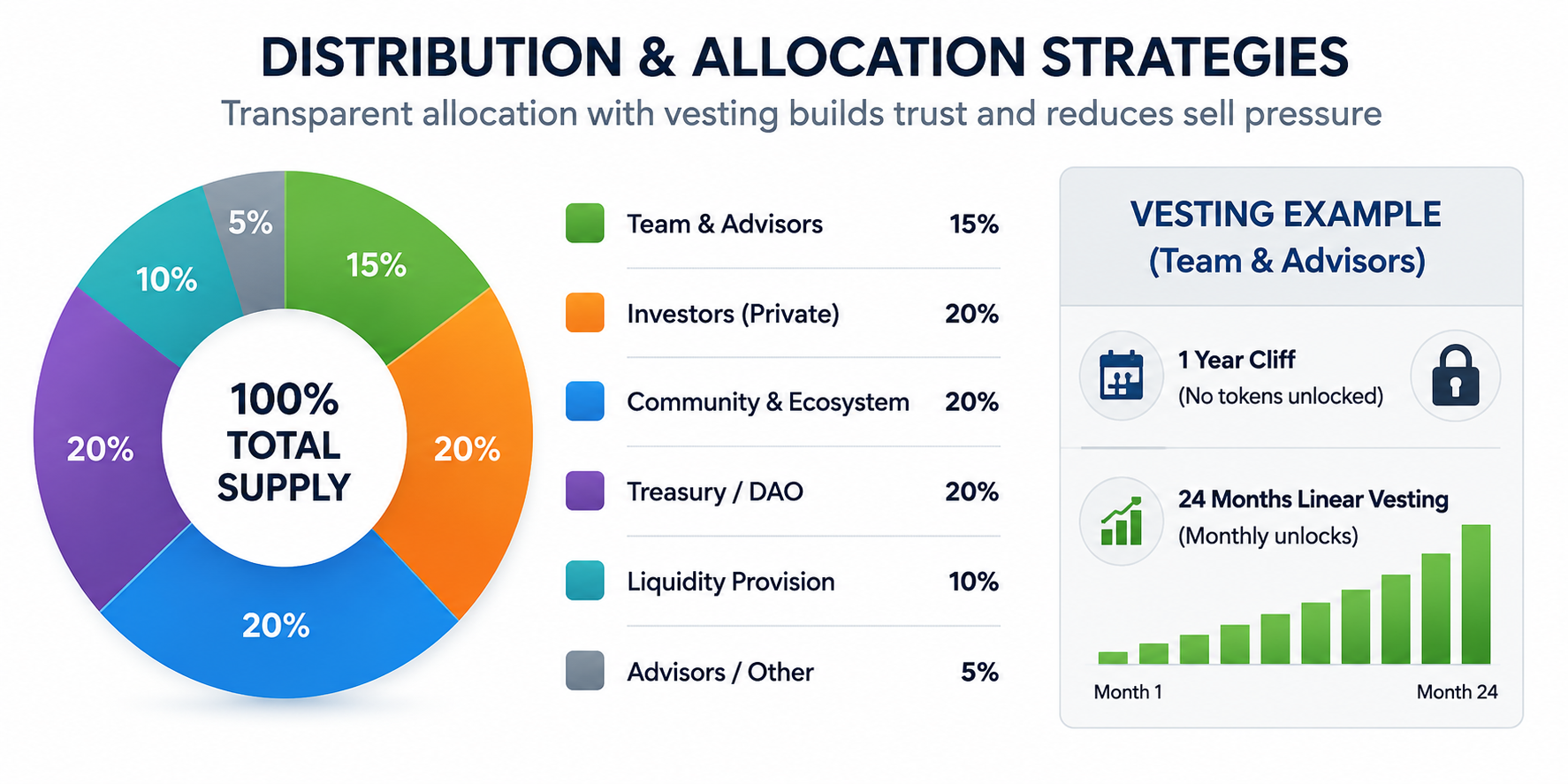
- Team & Advisors: 10–25%, ideally subject to multi-year vesting (e.g., 1-year cliff + 24–36 months linear release) to prevent rug pulls.
- Investors & Private Sales: Strategic rounds with discounts and lockups.
- Community & Ecosystem: Liquidity mining, airdrops, public sales, developer grants.
- Treasury/DAO: Funds for ongoing development, marketing, and partnerships.
- Liquidity Provision: Seeding DEX pools.
Transparent distribution fosters trust. Large, unlocked allocations to insiders increase the risk of significant sell pressure after the TGE (Token Generation Event). On-chain analytics, such as tracking the concentration of holdings among the top 100 wallets, can help investors assess whale-related risks and ownership concentration. Progressive decentralization is a common approach in which projects begin with a more centralized structure during the early stages of development and gradually transfer decision-making authority to the community through DAO governance and voting mechanisms as the ecosystem matures.
Vesting schedules are crucial. They signal long-term commitment and smooth token release into the market, mitigating volatility. Investors should also monitor tokenomics vesting updates to stay informed about upcoming token unlocks and potential market impacts.
3. Token Utility: The Engine of Organic Demand
Utility transforms a token from speculative asset to indispensable infrastructure component. Core utility categories:
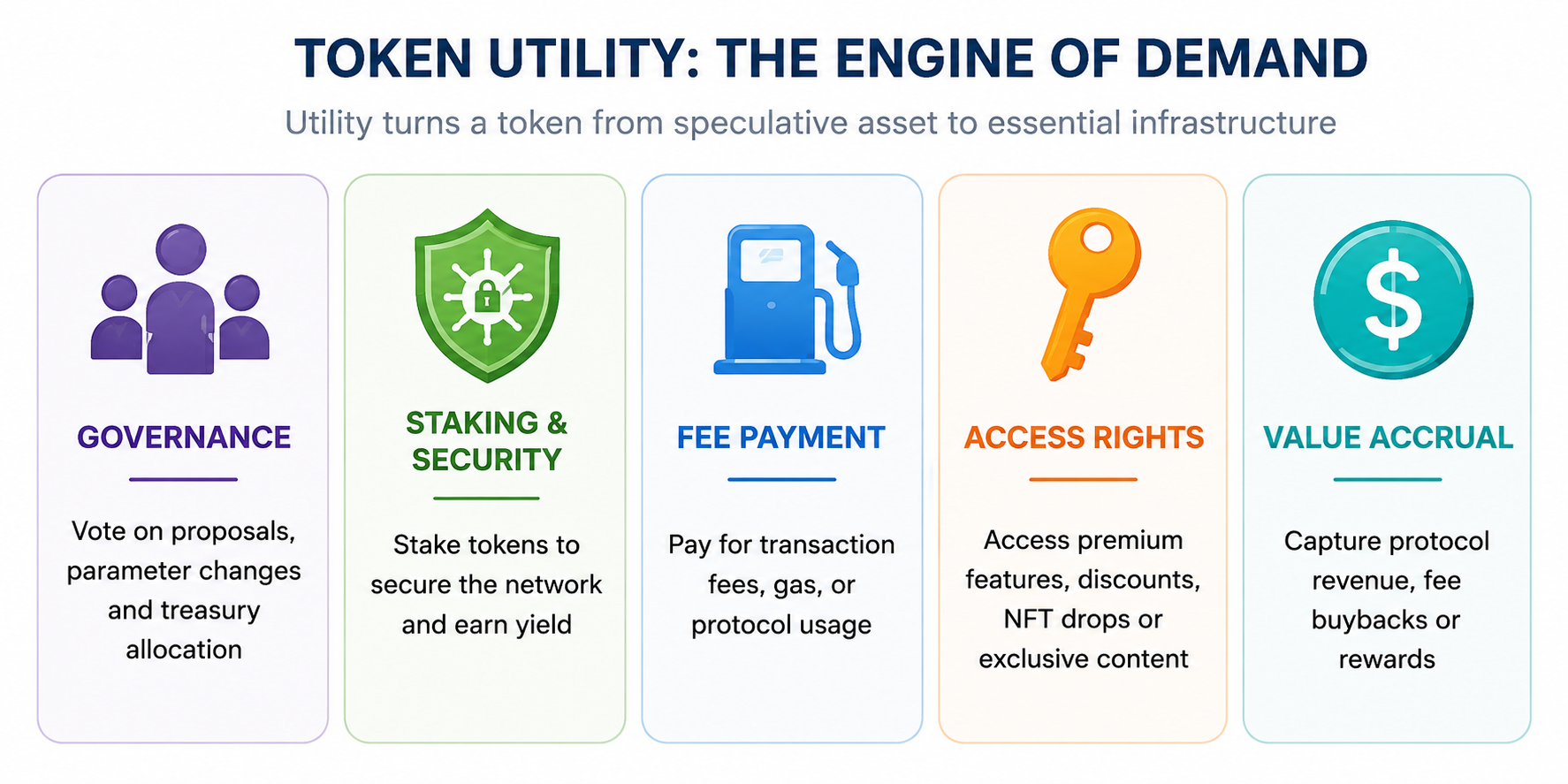
- Governance: Token holders vote on proposals, parameter changes, or fund allocation (e.g., DAO treasuries).
- Staking & Security: In Proof-of-Stake networks, staked tokens secure the chain and earn yields, reducing circulating supply.
- Fee Payment: Gas tokens (ETH, SOL, BNB) or specialized fee tokens.
- Access Rights: Exclusive features, discounted trading, premium NFTs, or yield boosts.
- Value Accrual: Revenue sharing, fee buybacks, or staking derivatives.
In DeFi, tokens that capture a portion of protocol fees (e.g., via veToken vote-escrow models inspired by Curve) create powerful alignment. Holders lock tokens for voting power and boosted rewards, encouraging long-term commitment. Gaming tokens might grant in-game assets, land ownership, or play-to-earn mechanics. Real World Assets (RWAs) tokenization links economics to tangible yields from bonds, real estate, or invoices. Effective utility creates a positive feedback loop: adoption increases demand for the token, which improves network security and features, attracting more users.
4. Incentive Mechanisms and Governance
Incentives are the behavioral nudges that drive participation. Liquidity provider rewards, staking APYs, airdrop campaigns, and contributor bounties bootstrap early activity. However, overly generous “farm-and-dump” incentives often attract mercenary capital that exits once rewards taper.
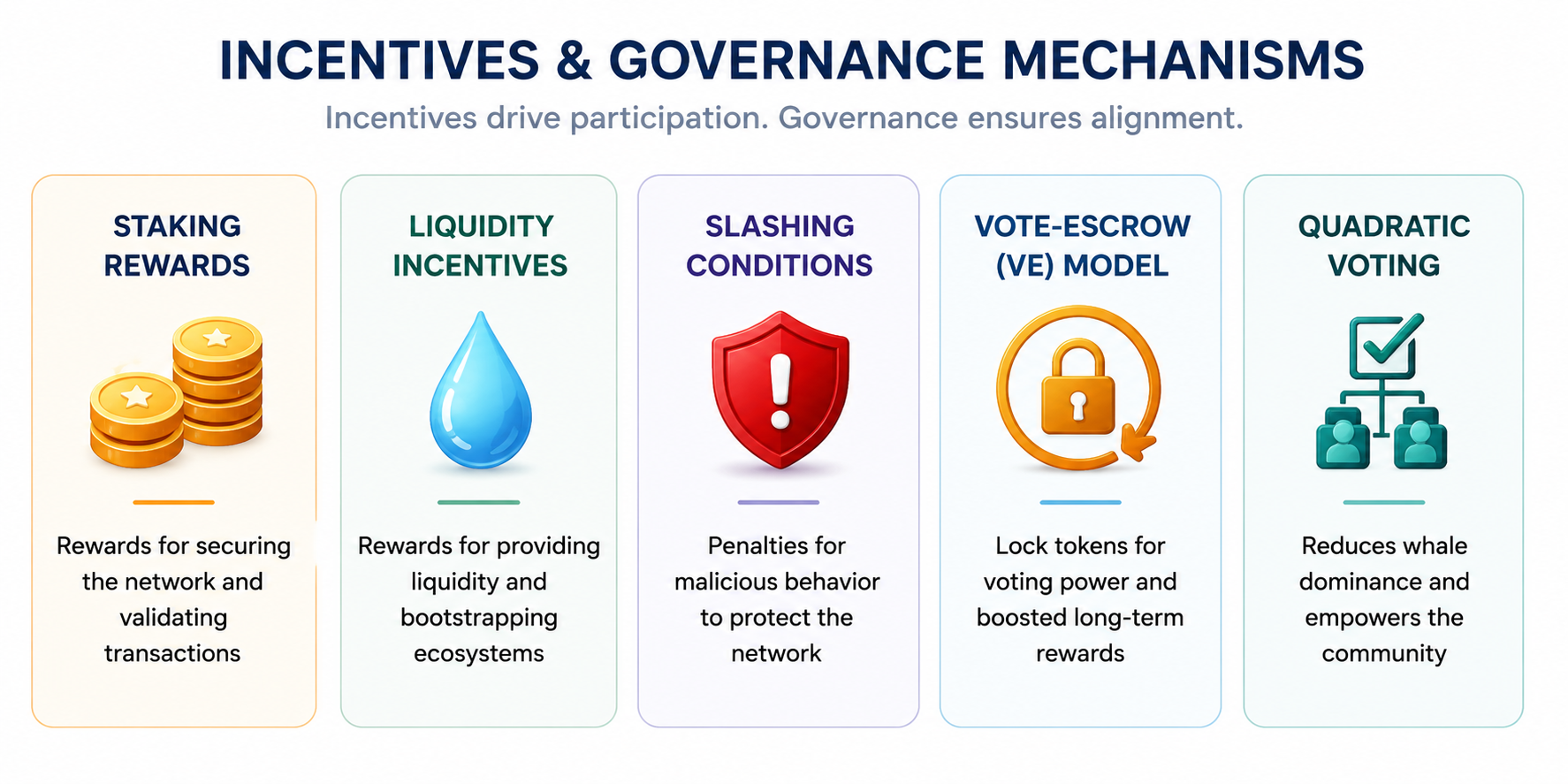
Advanced designs incorporate:
- Slashing Conditions: Penalties for validator misbehavior.
- Vote-Escrow (ve) Models: Time-weighted voting to favor committed holders.
- Quadratic Voting: Mitigates whale dominance.
- Soulbound or Non-Transferable Tokens: For reputation or governance credentials.
Governance evolution matters. Early stages are often foundation-controlled for speed, gradually shifting to on-chain DAO voting. Successful projects implement timelocks, multi-sig requirements, and community proposal thresholds to balance agility with security.
Why Tokenomics Matters: Stakeholder Perspectives
For Project Builders and Teams: Tokenomics is the primary tool for capital formation, user acquisition, and network security without traditional VC equity dilution. It enables bootstrapping via fair launches or IDOs while aligning incentives so that success benefits all participants. Poor tokenomics leads to unsustainably high inflation, validator centralization, or governance attacks, dooming even technically superior projects.
For Investors and Traders: Tokenomics analysis is fundamental due diligence. It helps differentiate projects with sustainable economics from hype-driven memecoins. Key questions: Is there real revenue or usage driving demand? What is the unlock schedule? Does the model favor long-term holders? Metrics like token velocity (how quickly tokens change hands) and monetary premium (value beyond utility) provide deeper insights. High-quality tokenomics correlates with better risk-adjusted returns over multi-year horizons.
For Users and the Broader Ecosystem: Strong tokenomics promotes genuine participation rather than speculation. It underpins decentralized finance, NFT ecosystems, decentralized physical infrastructure (DePIN), and AI-agent economies, while robust DeFi security remains critical for sustaining long-term ecosystem growth. In a maturing market, regulators increasingly scrutinize utility versus security status, making compliant, utility-rich designs essential for longevity. Network effects amplify: secure, incentive-aligned chains attract developers, liquidity, and users, creating winner-take-most dynamics in sectors like layer-1 infrastructure.
Expanded Real-World Examples
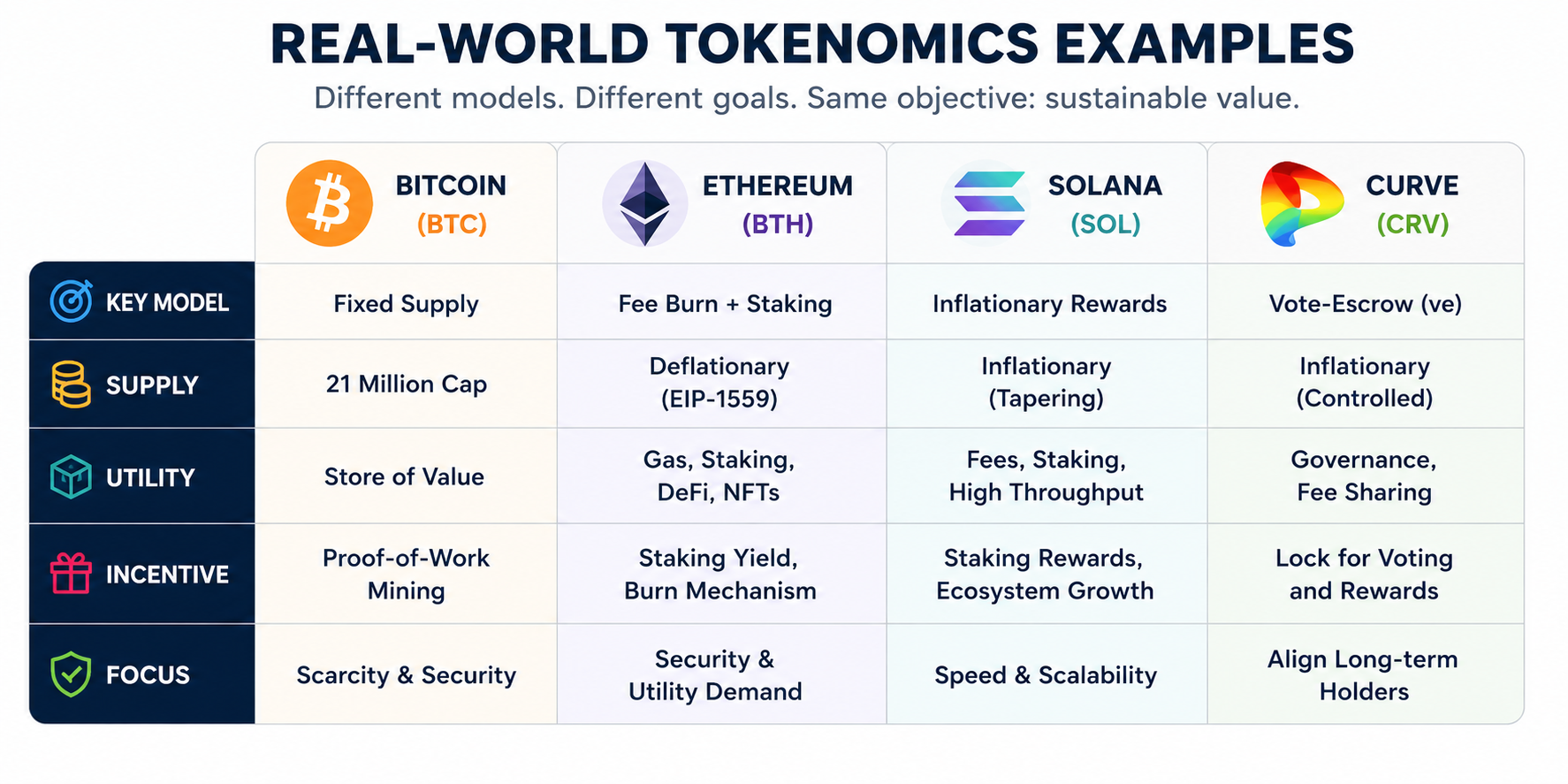
Bitcoin: Remains the gold standard. Halvings create periodic supply shocks every four years, historically preceding major bull runs. No pre-mine, no team allocation, pure meritocratic issuance via mining. The principles outlined in the Bitcoin Whitepaper continue to influence the design of decentralized monetary systems. Its simplicity has enabled it to function as a global settlement layer and inflation hedge.
Ethereum: Post-Merge PoS transition and EIP-1559 have made ETH increasingly deflationary during network congestion. Staking yields secure the chain (over 30% of supply staked in recent years), while gas fees and layer-2 activity drive demand. Governance through core devs, EIPs, and client diversity demonstrates resilient evolution.
Solana: High-performance architecture paired with inflationary rewards that taper. Ecosystem funds and developer incentives fueled explosive growth in DeFi and consumer apps. Recent Solana ecosystem performance reflects its ability to attract users, developers, and liquidity across multiple sectors. While facing occasional outage critiques, its tokenomics supported rapid validator expansion and memecoin activity.
Curve (CRV): Introduced the vote-escrow (veCRV) model, rewarding users who lock tokens for governance and enhanced incentives. Fee sharing and liquidity rewards align long-term holders with protocol growth and ecosystem sustainability.
DeFi Blue-Chips: Protocols using dual-token or veToken models reward governance participants with protocol-owned revenue. This shifts value from transient liquidity mining to sustainable yield, reducing sell pressure as Total Value Locked (TVL) grows.
In emerging sectors:
- Gaming (Play-to-Earn 2.0): Sustainable models tie token earnings to skill, time, or asset ownership rather than infinite inflation.
- RWAs: Tokens represent fractional ownership with embedded yields, bridging TradFi yields to on-chain liquidity.
- DePIN: Tokens incentivize hardware deployment (e.g., wireless networks, storage) with usage-based rewards.
Common pitfalls include excessive initial inflation without utility sinks, concentrated allocations, and ignoring token velocity. Projects that learn from past cycles by implementing revenue-sharing and adaptive supply adjustments tend to outperform.
Practical Guide: How to Evaluate Tokenomics
- Start with Documentation: Scrutinize the whitepaper, tokenomics section, and audit reports. Look for clear supply schedules, allocation visuals, and economic models.
- Quantitative Analysis:
- Circulating supply vs. FDV.
- Vesting/unlock calendars (TokenUnlocks, project dashboards).
- Holder distribution and Gini coefficient approximations via explorers.
- Qualitative Assessment: Does utility create recurring demand? Are incentives aligned across short- and long-term participants? Review governance history and proposal outcomes.
- On-Chain Analysis: Evaluate transaction activity, active users, staking participation, protocol revenue, treasury health, and governance engagement to assess a project’s long-term sustainability.
- Red Flags: Massive unlocked team allocations, vague utility, unsustainable APYs without revenue, anonymous teams, or copy-paste tokenomics from failed projects.
- Comparative Benchmarking: Compare against category leaders. Simulate scenarios: What happens to token price if adoption doubles? If rewards halve?
Continuous monitoring is essential tokenomics can evolve via governance votes.
Emerging Trends and Future Directions (2026 Onward)
The next phase of tokenomics emphasizes sustainability and regulatory alignment:
- Revenue Capture and Real Yield: More protocols distribute actual protocol fees rather than inflationary rewards.
- Hybrid Models: Combining governance with yield-bearing mechanics or staking derivatives.
- AI-Optimized Incentives: Dynamic adjustment of parameters using on-chain data and machine learning.
- RWA and Tokenization Boom: Economics tied to real-world cash flows, improving predictability and attracting institutions.
- Interoperability and Composability: Cross-chain tokenomics enabling seamless value flow.
- Privacy-Preserving and Compliant Designs: Zero-knowledge proofs for governance while satisfying KYC/AML in certain jurisdictions.
- Sustainability Focus: Energy-efficient models and carbon-aware incentives.
As stablecoins and tokenized assets grow, tokenomics will increasingly mirror traditional corporate finance while retaining decentralized advantages. Builders who simulate economic stress tests and incorporate feedback loops will build antifragile systems.
Risks, Common Mistakes, and Best Practices
Risks include smart contract vulnerabilities, governance exploits (e.g., flash-loan attacks), governance token accumulation attacks, regulatory reclassification as securities, and macroeconomic shocks affecting liquidity. Common mistakes: Over-optimizing for short-term hype, ignoring velocity, poor vesting design, and failing to model hyper-growth or stagnation scenarios.
Best practices for builders:
- Engage economic auditors early.
- Prioritize broad, fair distribution.
- Build multiple utility layers.
- Plan for progressive decentralization.
- Maintain transparent communication via dashboards and AMAs.
For investors: Diversify, allocate based on conviction in the model, and never invest more than you can afford to lose.
Conclusion
Tokenomics is the invisible architecture shaping the success or failure of crypto projects. It matters because it directly influences security, adoption, fairness, and value creation in decentralized systems. In an industry characterized by volatility and innovation, projects with robust, adaptive tokenomics stand the best chance of delivering lasting impact whether as infrastructure layers, financial primitives, or consumer applications.
Mastering tokenomics empowers better decision-making for all participants. Builders can design more resilient protocols. Investors can separate signal from noise. Users can participate meaningfully in ecosystems that reward contribution. As crypto integrates deeper with traditional finance and real-world use cases, thoughtful tokenomics will separate enduring winners from temporary experiments. Approach every project with rigorous analysis, demand transparency, and prioritize utility and alignment. The future of decentralized economies depends on it.
Disclaimer: Cryip's content is strictly for educational and informational purposes and does not constitute financial, legal, or investment advice. Cryptocurrency involves significant risk, and readers assume full responsibility for their own financial decisions. Asset references are never endorsements.
To make complex crypto topics accessible to readers at all experience levels, our team uses AI tools strictly to refine language, correct grammar, and simplify terminology. AI is never used to draft facts, source information, or form conclusions. Every article is fact-checked and approved by a human editor before publication. Read our full AI Use & Content Policy.