




The $1.8 trillion asset manager’s Treasury token reaches a new exchange in Asia even as its total on-chain value has slipped over the past month.
- Franklin Templeton’s OnChain U.S. Government Money Fund (BENJI) went live on HashKey Exchange’s Earn channel for professional investors in Hong Kong on August 24, 2026.
- The listing follows Franklin’s first Hong Kong tokenized-fund pilot with HSBC and OSL in November 2025, and arrives four days after Franklin said it had won SEC clearance to hold tokenized assets inside its traditional ETFs and mutual funds.
- On-chain tracking shows BENJI’s total value across eight blockchains was about $720 million as of August 25, 2026, down roughly 2% over the prior 30 days, with nearly two-thirds of it still sitting on Stellar.
Franklin Templeton’s tokenized U.S. government money market fund is now available to professional investors on HashKey Exchange, giving the Hong Kong-licensed platform direct access to the $1.8 trillion asset manager’s on-chain Treasury product starting August 24, according to a joint announcement.
The fund, known as BENJI, will sit on HashKey’s Earn channel under the ticker grBENJI, restricted to professional investors under Hong Kong’s Securities and Futures Ordinance rather than offered to the general public. Haiyang Ru, chief executive of HashKey Exchange‘s business group, called the tie-up a “monumental milestone” for the platform, while Chetan Karkhanis, Franklin’s senior vice president for digital assets client engagement, said the launch is “a key step in broadening our reach” across the region.
Franklin Templeton Builds BENJI’s Asia Distribution Network
The timing makes this more than a routine distribution deal. It is the second step in a pattern Franklin started building nine months ago. In November 2025, the firm rolled out Hong Kong’s first tokenized money market fund through a regulatory sandbox arrangement with HSBC and digital asset platform OSL, a pilot built around bank custody rather than a crypto-native exchange.
The HashKey listing moves the same underlying fund onto a licensed exchange’s own retail-facing infrastructure, the kind of distribution that actually reaches traders rather than sitting inside a sandbox. It also lands four days after Franklin disclosed it had received U.S. regulatory clearance to let its traditional ETFs and mutual funds. The expansion also reflects HashKey banking partnerships as the exchange builds deeper connections with traditional financial institutions.
- More than 130 vehicles are covered by the clearance.
- Those ETFs and mutual funds manage about $872 billion combined.
- The clearance allows them to hold or post BENJI as collateral.
Read together, the two moves describe a single strategy: tokenized Treasury exposure pushed simultaneously into Franklin’s existing fund lineup at home and onto crypto-native exchanges abroad, rather than left as a standalone product on either side. Franklin Templeton Bitcoin ETFs would further extend that digital-asset strategy beyond tokenized Treasury products.
That strategy is landing against a backdrop of real growth in the broader market. Tokenized real-world assets tracked on-chain totaled roughly $38.2 billion as of August 23, 2026, according to on-chain tracking site RWA.xyz, up from about $20.6 billion a year earlier, with tokenized U.S. Treasury debt accounting for roughly $15.6 billion of that total. Franklin’s own tokenized Treasury assets under management have grown by roughly 100% this year to around $2.5 billion, by its own published figures.
BENJI’s Blockchain Footprint Shows Limited Momentum
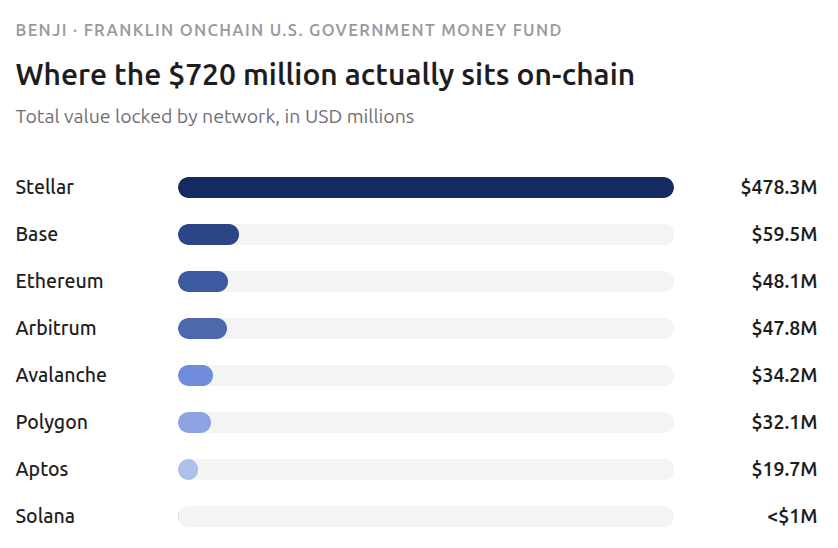
But BENJI’s own on-chain footprint tells a narrower story than the expansion announcement suggests. RWA.xyz data shows the fund’s combined value across eight networks, Stellar, Base, Ethereum, Arbitrum, Avalanche, Polygon, Aptos and Solana, actually slipped about 2% over the 30 days leading into the HashKey launch, even as its holder count ticked up slightly.
Roughly two-thirds of that value still sits on Stellar, the chain Franklin used when it first tokenized the fund in 2021. HashKey’s listing does not add a new chain to that mix; it wraps the existing fund into a new distribution channel. The gap between a shrinking on-chain balance and an expanding list of places to buy the fund suggests Franklin’s tokenized Treasury growth this year has come mostly from new products and partnerships rather than from more capital flowing into BENJI itself. The 250 Digital acquisition could give Franklin another route to expand its crypto investment offering as it builds beyond tokenized Treasury products.
Karkhanis said Franklin intends to keep building on the relationship. “We look forward to deepening this partnership by expanding beyond tokenized money market funds into other tokenized products over time,” he said. Whether that follow-through changes BENJI’s on-chain numbers, or simply adds another venue to a fund whose underlying balance has been flat, is the thing worth watching next. The move also comes as Franklin Templeton expands its broader digital-assets strategy following its $250 million digital acquisition.
Disclaimer: Cryip's content is strictly for educational and informational purposes and does not constitute financial, legal, or investment advice. Cryptocurrency involves significant risk, and readers assume full responsibility for their own financial decisions. Asset references are never endorsements.
To make complex crypto topics accessible to readers at all experience levels, our team uses AI tools strictly to refine language, correct grammar, and simplify terminology. AI is never used to draft facts, source information, or form conclusions. Every article is fact-checked and approved by a human editor before publication. Read our full AI Use & Content Policy.