




- Kinetiq, the operator of Hyperliquid’s largest liquid-staking product, announced Elysium, a new Layer 2 for Hyperliquid that runs on HYPE as its gas token.
- Half of Elysium’s sequencer fee revenue is earmarked for open-market purchases of Kinetiq’s own token, KNTQ, all of which gets burned.
- The announcement lands as Kinetiq’s kHYPE staking token is said to have fallen from roughly 10% of all staked HYPE a year ago to under 5% now, even as its total value locked keeps climbing.
Kinetiq, the protocol behind kHYPE, Hyperliquid’s largest liquid-staking token, said on Aug. 24 that it is building Elysium, a new Layer 2 network for Hyperliquid designed to speed up spot trading, token launches and automated market-making. Elysium will use HYPE itself as its gas token rather than introducing a separate asset, and Kinetiq says it will connect directly to HyperCore, Hyperliquid’s native order book, for faster block times than the existing HyperEVM environment, as the broader ecosystem also moves toward developments such as the Hyperliquid HIP-4 testnet launch.
Kinetiq has not set a mainnet date, published technical specifications, named infrastructure partners or disclosed audits. It says those details are coming “soon.” “HyperEVM, in effort to compose with HyperCore, has introduced complexities that perplex even the most talented builders and sophisticated traders,” Kinetiq wrote, adding that a simple swap on HyperEVM has cost as much as $20 during periods of heavy activity.
Why Kinetiq Is Building a Second Revenue Line
Elysium’s fee design points to a motive beyond fixing HyperEVM’s congestion. Of every dollar Elysium’s sequencer collects, 50 cents goes toward buying KNTQ on the open market and burning it, 25 cents goes to the applications that generate the activity, and 25 cents goes to Kinetiq’s own treasury. That mechanism ties KNTQ’s value to how much people trade on Elysium, a revenue source that has nothing to do with how much HYPE is staked through Kinetiq.
That distinction matters because Kinetiq’s core staking business looks weaker underneath a strong headline number. Kinetiq’s total value locked has climbed to roughly $1.26 billion, up more than a third in the past month, according to DefiLlama.
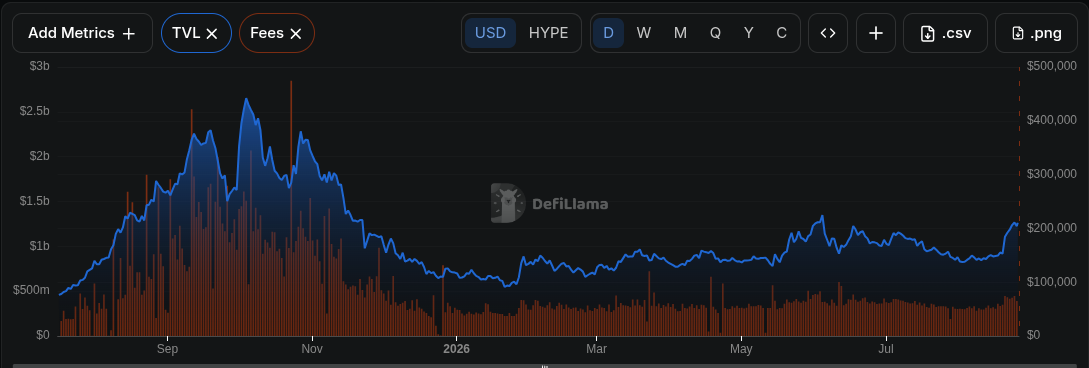
But kHYPE’s share of all staked HYPE on the network is said to have slid from about 10.4% a year ago to about 4.4% now, with kHYPE’s supply down sharply since last August. A protocol whose staking product is shrinking as a share of the market, even as its own dollar-denominated TVL rises with the price of HYPE, has a clear incentive to open a fee stream that scales with trading volume instead, amid broader activity such as the Ventuals HIP-3 markets shutdown.
KNTQ Rallies as HYPE Holds Steady After Elysium Announcement
KNTQ is said to have jumped as much as 30% within hours of the announcement. It has since given back part of that move: as of Aug. 25, KNTQ traded at $0.2289, up 9.94% over the prior 24 hours.
HYPE itself showed little reaction. The token dipped into the high $70s overnight before climbing back to roughly $80 by the following afternoon, a round trip rather than a sustained move. As of Aug. 25 at 11:51 UTC, HYPE was trading at $80.22, up 0.43% over 24 hours.
The timing of Elysium’s launch and the basis for its performance claims remain key factors, particularly without independent benchmarks. Whether Elysium becomes a real second revenue engine for KNTQ, rather than an announcement-day price spike, depends on whether Kinetiq can provide clarity on those points and whether kHYPE’s staking share keeps sliding once it does.
Disclaimer: Cryip's content is strictly for educational and informational purposes and does not constitute financial, legal, or investment advice. Cryptocurrency involves significant risk, and readers assume full responsibility for their own financial decisions. Asset references are never endorsements.
To make complex crypto topics accessible to readers at all experience levels, our team uses AI tools strictly to refine language, correct grammar, and simplify terminology. AI is never used to draft facts, source information, or form conclusions. Every article is fact-checked and approved by a human editor before publication. Read our full AI Use & Content Policy.