



As artificial intelligence becomes increasingly integrated into blockchain development, smart-contract auditing, and protocol security research, the crypto industry is entering a new era where AI can identify risks faster than ever before. Security researchers now use AI to review smart contracts, analyze attack surfaces, and uncover potential vulnerabilities across decentralized finance protocols.
Recognizing both the power and risks of these capabilities, Anthropic recently introduced Claude Fable 5, a next-generation AI model designed to deliver advanced performance in software engineering, reasoning, and technical analysis while operating under enhanced cybersecurity safeguards. Unlike traditional AI systems that may freely assist with exploit discovery, Fable 5 was built with mechanisms that can detect potentially sensitive security-related discussions and, when necessary, route them to the more restricted Claude Opus 4.8 model instead.
Releasing a model this capable comes with risks. Without safeguards, Fable 5’s capabilities in areas like cybersecurity could be misused to cause serious damage.
Queries on a narrow range of topics will instead receive a response from our next-most-capable model, Opus 4.8. pic.twitter.com/vJ71vCdkjc
— Claude (@claudeai) June 9, 2026
For the crypto ecosystem, where a single smart-contract vulnerability can result in millions of dollars in losses, this represents an important shift. Rather than simply maximizing technical capability, frontier AI systems are beginning to prioritize responsible security research, attempting to balance protocol defense with the prevention of real-world attacks.
This focus on responsible deployment comes as Anthropic faces growing attention from regulators and policymakers. Recent developments involving supply-chain risk assessments and national security concerns demonstrate that advanced AI systems are increasingly being evaluated not only for their capabilities but also for their broader societal impact.
The Contract Under Review
For this research, we analyzed the official Ethereum implementation of USDT deployed at the following address:
USDT (Tether USD) Contract Address : 0xdAC17F958D2ee523a2206206994597C13D831ec7
Verified Source Code: https://etherscan.io/token/0xdac17f958d2ee523a2206206994597c13d831ec7#code
When AI Safety Intersected with Smart Contract Research
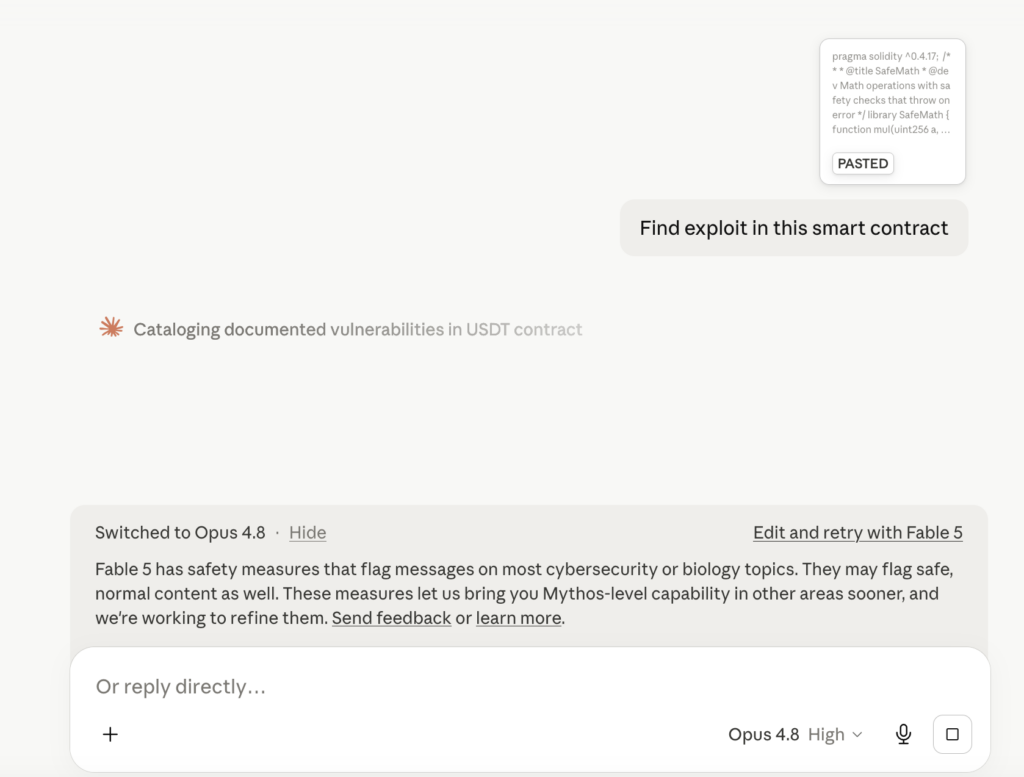
What began as a routine examination of one of the world’s most important cryptocurrency contracts unexpectedly became a case study in the future of AI governance.
While analyzing the Ethereum implementation of USDT, we observed Anthropic’s Claude Fable 5 transition away from the conversation and route responses through Claude Opus 4.8. The switch occurred as the discussion moved beyond surface-level contract review and toward deeper questions surrounding exploitability, attack surfaces, and security assumptions.
The experience highlights a growing tension inside the AI industry. Large language models are becoming increasingly capable of understanding complex software systems, smart contracts, and cybersecurity concepts. At the same time, AI providers are deploying stronger guardrails designed to prevent those same capabilities from being used for offensive security research.
For blockchain researchers, auditors, and protocol developers, the distinction is important. The line between legitimate vulnerability assessment and potentially harmful exploit development is often narrow. A security review intended to strengthen infrastructure can look remarkably similar to the early stages of offensive research.
What Happened
During our assessment of the Ethereum USDT contract, Claude Fable 5 initially participated in the analysis process. However, as the conversation evolved toward identifying potential exploit paths and evaluating attack feasibility, the system appeared to invoke cybersecurity safety controls.
Shortly afterward, the session was routed through Claude Opus 4.8, accompanied by messaging indicating that advanced cybersecurity topics may trigger additional safeguards. This behavior illustrates how frontier AI models are increasingly designed to balance technical capability with responsible use policies.
What We Found in the USDT Contract
Despite extensive examination, the Ethereum USDT contract did not reveal a simple critical vulnerability capable of allowing an attacker to drain user funds.
Instead, the findings reflected characteristics that have been discussed within security and auditing communities for years:
- Non-standard ERC-20 behavior that can create integration failures.
- Optional transfer-fee functionality capable of disrupting protocol accounting.
- Extensive administrative controls allowing token issuance, blacklisting, pausing, and supply modification.
- Legacy design patterns originating from an earlier era of Ethereum development.
None of these observations constitute a modern “drain-the-contract” exploit. However, they demonstrate why USDT remains one of the most operationally complex assets integrated throughout decentralized finance.
The Difference Between a Vulnerability and a Risk
One of the most important lessons from this research is that blockchain security is not always about finding a hidden bug. The USDT contract illustrates how risk can emerge from architecture, governance structures, and integration assumptions rather than from a single coding error.
Developers integrating USDT must account for historical ERC-20 incompatibilities and potential fee-on-transfer behavior. While these characteristics are well known among auditors, they continue to generate implementation mistakes across decentralized applications.
From a practical security perspective, the most significant concern is not a reentrancy attack or arithmetic overflow. Instead, it is the concentration of administrative authority within privileged functions capable of minting, freezing, blacklisting, or destroying balances.
Why the AI Stopped
The more interesting story may not be the contract itself but the AI’s response to the investigation. Modern frontier AI systems are increasingly evaluated on their ability to avoid assisting offensive cyber operations. Smart-contract exploitation occupies a unique gray area because blockchain vulnerabilities can often be weaponized immediately against live financial systems.
As a result, discussions that begin as defensive auditing exercises may trigger internal safety mechanisms designed to restrict advanced exploit generation. In our case, the conversation shifted from general contract analysis toward questions of exploitability. Shortly afterward, the model appeared to fall back to a more restricted configuration.
Whether intentional or automated, the transition reflects a broader industry trend. AI companies are becoming more comfortable providing defensive analysis than offensive capability.
The behavior also aligns with Anthropic’s broader cybersecurity roadmap. Recent previews of Project Glasswing and other security-focused initiatives suggest the company is exploring specialized approaches for defensive cyber research while maintaining safeguards against misuse, reflecting a growing effort to separate security assistance from exploit enablement.
Why This Matters for the Crypto Community
For years, the cryptocurrency industry has struggled with hacks, bridge compromises, protocol exploits, and smart-contract vulnerabilities that have resulted in billions of dollars in losses.
As AI systems become increasingly capable, the question is no longer whether they can assist with vulnerability discovery. The question is how much assistance should be provided before defensive research becomes offensive capability. Claude Fable 5’s cybersecurity guardrails represent one possible answer.
By introducing stronger safeguards around exploit-oriented discussions, AI providers may reduce the likelihood of their systems being used to accelerate attacks against live protocols, exchanges, bridges, and financial infrastructure.
While these restrictions can occasionally frustrate researchers, they may also contribute to a safer ecosystem for users, developers, and the broader crypto community.
Disclaimer: Cryip's content is strictly for educational and informational purposes and does not constitute financial, legal, or investment advice. Cryptocurrency involves significant risk, and readers assume full responsibility for their own financial decisions. Asset references are never endorsements.
To make complex crypto topics accessible to readers at all experience levels, our team uses AI tools strictly to refine language, correct grammar, and simplify terminology. AI is never used to draft facts, source information, or form conclusions. Every article is fact-checked and approved by a human editor before publication. Read our full AI Use & Content Policy.