

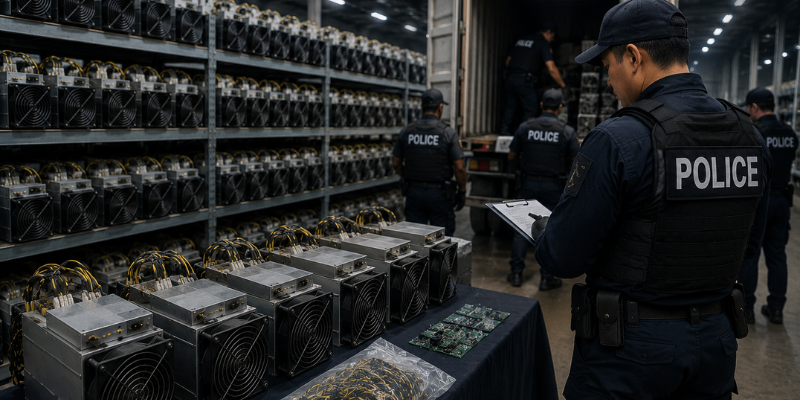


Thailand’s Department of Special Investigation (DSI) has significantly expanded its probe into illegal cryptocurrency mining operations after discovering connections to a transnational network allegedly run by Chinese financiers that authorities say processed more than $307 million (10 billion baht) annually from online scams and gambling proceeds.
What began as a routine electricity theft investigation has now evolved into one of the country’s largest cases linking illegal crypto infrastructure to cyber fraud and cross-border money laundering.
In 2025, the DSI’s Technology and Cyber Crime Bureau conducted multiple raids and dismantled three major illegal mining syndicates. Authorities seized more than 6,390 cryptocurrency mining rigs, which had reportedly consumed electricity worth 953 million baht, or approximately $29 million, from the Provincial Electricity Authority (PEA). The case is considered one of the largest instances of state utility theft in Thailand in recent years.
Financial Laundering Network
Investigators found that the mining operations were not isolated cases of electricity theft but allegedly formed part of a sophisticated financial ecosystem.
According to the DSI, the network used corporate entities and Thai bank accounts to move suspected criminal proceeds. Myanmar nationals were reportedly recruited to make large daily cash withdrawals ranging from 30 million to 50 million baht, or approximately $920,000 to $1.5 million, enabling the movement of more than 10 billion baht per year.
The findings come as authorities globally intensify investigations into Chinese-linked financial and cybercrime networks. Earlier this month, the FBI seized 13 fake consulting websites that prosecutors said were used to conceal operators and facilitate intelligence-gathering activities.
Authorities believe the illegal mining infrastructure may have been used both to generate revenue and to facilitate the movement of funds linked to call center scams, online fraud, and transnational gambling activities.
Arrest Warrants Issued
The DSI has issued arrest warrants for eight suspects, comprising four Chinese financiers and four Myanmar nationals. Authorities are seeking seven additional warrants and have summoned five more individuals to face formal charges. Prosecutors are currently preparing the full case file for trial.
A key individual named in the investigation is Wang Yicheng. Thai authorities said they received intelligence from the US Secret Service linking him to a major digital asset fraud scheme.
The US agency previously seized more than $17.8 million in cryptocurrency assets connected to Wang as part of a broader fraud case that allegedly caused losses exceeding $61 million. Authorities have not disclosed the specific digital assets involved.
Corruption Angle
The investigation has also exposed alleged complicity by local officials and insiders. The DSI has forwarded two separate case files to Thailand’s National Anti-Corruption Commission (NACC) targeting seven PEA officials, one law enforcement officer, and 13 investors or alleged accomplices. These individuals are suspected of providing protection or technical assistance that allowed the mining operations to run undetected for a prolonged period.
Authorities are investigating whether assistance from insiders enabled the operations to continue for an extended period.
Regional Crackdown on Cybercrime
The case forms part of Thailand’s wider efforts to combat the growing intersection of cryptocurrency infrastructure and transnational organized crime in Southeast Asia.
In October 2024, under Operation Crypto Crack, the DSI raided several mining sites in Kanchanaburi and seized hundreds of rigs. Earlier in 2026, authorities also seized assets worth more than 20 billion baht linked to various transnational scam networks.
Earlier in 2026, the DSI submitted charges against eight suspects in the P Miner Cryptocurrency Group Ponzi Scheme, a crypto investment and Bitcoin mining fraud case that allegedly promised investors annual returns of between 69% and 419%. Authorities seized more than 250 million baht in assets linked to the scheme, including bank deposits, digital assets, real estate, life insurance policies, and luxury vehicles, as part of efforts to compensate victims.
Thailand has also intensified cooperation with international law enforcement agencies as Southeast Asia becomes an increasingly important hub for online investment scams and crypto-enabled money laundering operations. Investigators across the region have focused on criminal networks operating across Myanmar, Cambodia, and Thailand that rely heavily on digital assets and informal payment channels to move illicit proceeds.
The Thai investigation also contrasts with efforts in some countries to promote cryptocurrency mining as an economic opportunity. Earlier this year, Colombian President Gustavo Petro proposed using Bitcoin mining to support economic development along the country’s Caribbean coast.
The investigation adds to growing concerns among law enforcement agencies that cryptocurrency infrastructure can be used alongside fraud, illegal gambling, and money laundering operations across the region.
The DSI said it continues to work with international partners, including US law enforcement agencies, and will accelerate evidence collection as the case moves toward prosecution.
Disclaimer: Cryip's content is strictly for educational and informational purposes and does not constitute financial, legal, or investment advice. Cryptocurrency involves significant risk, and readers assume full responsibility for their own financial decisions. Asset references are never endorsements.
To make complex crypto topics accessible to readers at all experience levels, our team uses AI tools strictly to refine language, correct grammar, and simplify terminology. AI is never used to draft facts, source information, or form conclusions. Every article is fact-checked and approved by a human editor before publication. Read our full AI Use & Content Policy.