



May 2026 web traffic for centralized cryptocurrency exchanges (CEXs) confirms a highly stratified yet globally interconnected market, where a small group of large platforms captures most user attention while a long tail of exchanges competes through regional focus and specialized products. Binance remains the dominant global hub by visits, while OKX, Coinbase, BingX, KuCoin, MEXC, Gate, LBank, BitMart, and Bybit form a dense upper tier that defines much of the retail trading landscape.
At the same time, the data highlights a persistent divide between globally diversified exchanges and hyper-local platforms such as Upbit, Bithumb, CoinDCX, and Bitvavo, where traffic is overwhelmingly concentrated in a single country. This structural split underscores how regulatory regimes, fiat on-ramp infrastructure, and local brand trust continue to shape user behavior as much as global marketing or product breadth.
Top exchanges by May 2026 web traffic
Top 10 by latest monthly visits
The May 2026 confirms that Binance remains the clear traffic leader among centralized exchanges, with a deeply diversified global user base and no single country dominating activity. The rest of the top 10 – including BingX, OKX, Coinbase, MEXC, KuCoin, LBank, Gate, Bybit, and BitMart – form a dense upper tier that collectively defines where most retail CEX trading attention and competition are currently concentrated.
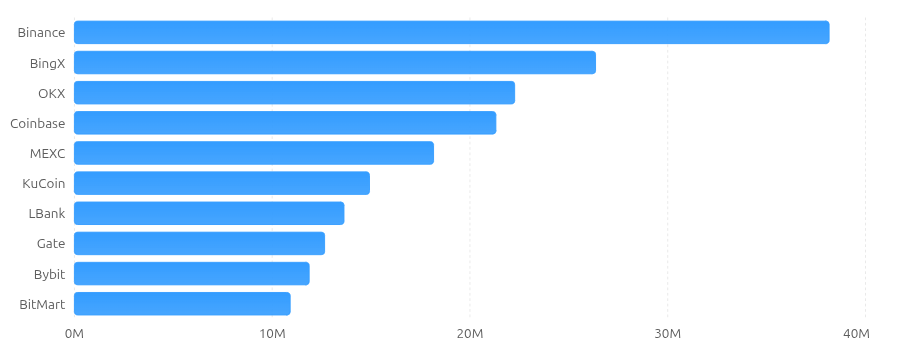
Binance: Binance leads May 2026 with approximately 38.16 million total web visits, sustaining its position as the largest centralized exchange by user traffic. Its audience is globally diversified, with India (8.20%), the Republic of Korea (8.17%), Brazil (6.13%), Ukraine (5.40%), and Turkey (4.93%) contributing significant shares and no single country dominating usage. This distribution reinforces Binance’s role as the default global CEX for retail traders across Asia, Europe, and key emerging markets.
BingX: BingX generated approximately 26.35 million visits, placing it in the upper tier of exchanges by web traffic. It has a strongly emerging‑market skew, with Kazakhstan (24.02%), Turkey (23.78%), Australia (15.37%), Argentina (14.55%), and Thailand (2.88%) accounting for most visits, highlighting its appeal in regions facing currency volatility and capital controls.
OKX: OKX remained a tier‑one platform with about 22.26 million visits in May. Its top markets include Japan (8.42%), the United States (7.29%), the Philippines (7.19%), Turkey (4.76%), and Brazil (4.51%), signalling a balanced presence across East Asia, North America, and high‑growth emerging markets. OKX’s X Layer Introduces Exchange OS, reinforcing its push toward an integrated on-chain and exchange infrastructure ecosystem.
Coinbase: Coinbase recorded roughly 21.31 million visits in May, solidifying its status as the leading regulated U.S. exchange. Its traffic is heavily concentrated in the United States (67.99%), followed by the United Kingdom (5.25%), Germany (2.75%), France (2.34%), and Canada (2.13%), underscoring a distinctly Western and U.S.-centric profile.
MEXC: MEXC saw about 18.16 million visits in May, cementing it as a major challenger in the derivatives and altcoin segments. Its user base is driven by Vietnam (7.50%), the United States (6.88%), India (6.49%), Singapore (5.66%), and the Philippines (4.75%), indicating a deep focus on Southeast Asia and major emerging markets with meaningful U.S. participation.
KuCoin: KuCoin logged around 14.92 million visits, supported by a diversified international audience. Its main traffic sources are the Philippines (7.57%), Turkey (7.34%), the United States (4.92%), India (4.89%), and Singapore (4.82%), aligning with its positioning as a global altcoin and retail‑trader hub.
LBank: LBank attracted about 13.63 million visits, placing it in the upper mid‑tier by scale. Its user base is dominated by the Philippines (9.57%), Turkey (6.73%), Azerbaijan (4.47%), Argentina (4.06%), and Singapore (3.80%), giving it a distinctly emerging‑market heavy profile.
Gate: Gate recorded roughly 12.65 million visits. Its traffic mix spans the United States (9.68%), Turkey (6.15%), the Republic of Korea (5.54%), the Philippines (5.20%), and Singapore (4.21%), reflecting its strategy of serving altcoin traders and derivatives users across both developed and emerging markets.
Bybit: Bybit logged around 11.87 million visits with a strong regional skew. Its user base is heavily concentrated in Russia (30.38%), followed by the Republic of Korea (8.49%), Ukraine (6.63%), Belarus (3.39%), and Turkey (2.37%), emphasizing its popularity among derivatives traders in Eastern Europe and parts of Asia.
BitMart: BitMart reached approximately 10.91 million May visits. It draws traffic from the United States (12.28%), the Philippines (8.43%), Taiwan (5.71%), Turkey (5.26%), and Singapore (4.29%), underscoring its role as a global retail gateway for users across Asia and North America.
Momentum and month‑on‑month traffic changes
The May figures also include a Month Change field, capturing how traffic shifted versus the previous month and revealing clear winners and losers in momentum when compared with CEX Web Traffic in April 2026. While the precise baseline is not presented here, the percentage changes provide a directional view of where attention is accelerating or fading.
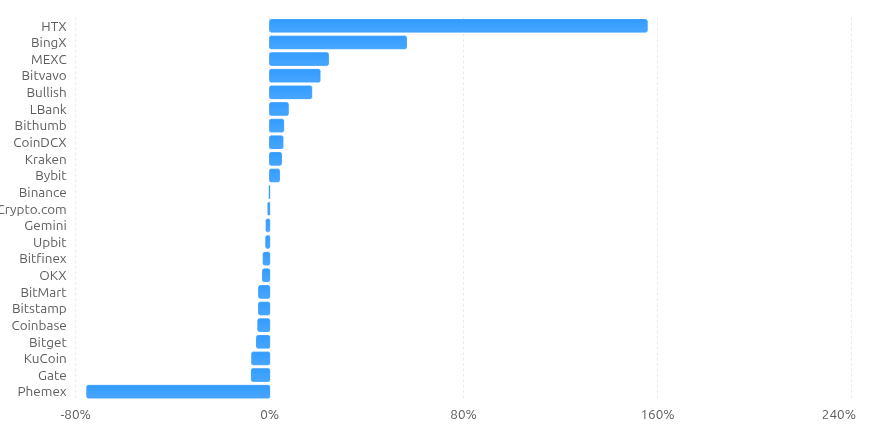
Most large exchanges show modest negative Month Change values, consistent with a consolidation phase after earlier bursts of speculative activity. Binance (−0.17%), Coinbase (−4.86%), Upbit (−1.58%), OKX (−2.91%), Bitget (−5.40%), Gate (−7.53%), KuCoin (−7.37%), BitMart (−4.53%), Bitstamp (−4.55%), Bitfinex (−2.66%), Gemini (−1.45%), Crypto.com (−0.69%), and Phemex (−75.40%) all saw declines of varying magnitudes.
In contrast, a handful of exchanges reported strong positive Month Change:
- BingX: +56.40%, indicating very rapid growth on top of an already high visit base.
- HTX: +155.70%, suggesting a more-than‑doubling of traffic from its prior level.
- MEXC: +24.23%, reflecting renewed interest in its derivatives and altcoin offerings.
- Bitvavo: +20.77%, signalling solid growth within a primarily European footprint.
- Bullish: +17.33%, indicating rising presence despite a smaller absolute traffic base.
- LBank: +7.68%, Bithumb: +5.77%, CoinDCX: +5.47%, Bybit: +4.02%, and Kraken: +4.86% show steady positive trends.
These divergences confirm that May 2026 was not a uniform expansion or contraction in user attention, but rather a rotation, with traffic shifting from some established venues toward aggressive, regionally focused platforms.
Regional patterns and country‑level concentration
May 2026 web traffic again divides exchanges into four structural archetypes, defined by how geographically concentrated or diversified their user bases are.
Korea‑centric exchanges
Upbit and Bithumb remain archetypal hyper‑localized exchanges.
- Upbit sources 97.58% of its traffic from the Republic of Korea, with only minor shares from Indonesia (0.49%), the United States (0.29%), Vietnam (0.20%), and Turkey (0.18%).
- Bithumb is similarly concentrated, drawing 97.76% of visits from the Republic of Korea, followed by small contributions from the United States (0.73%), Indonesia (0.24%), Vietnam (0.15%), and Malaysia (0.13%).
Such extreme domestic concentration underscores deep brand trust and strong fiat connectivity in a single market, but it also concentrates macro and regulatory risk.
India‑anchored exchanges
India has emerged as another clear example of a hyper‑local yet systemically important CEX market, with multiple platforms deriving the majority of their traffic from domestic users.
- CoinDCX is overwhelmingly India‑first, with 79.59% of May 2026 visits coming from India, followed by the United States (5.27%), Vietnam (2.04%), Norway (1.56%), and South Africa (0.89%).
- WazirX shows a similarly concentrated profile, generating 78.58% of May visits from India, with secondary flows from the United States (4.53%), Mexico (1.78%), Sri Lanka (1.36%), and Nigeria (1.17%).
- CoinSwitch also fits this pattern: 66.67% of May visits originate in India, while the United States (15.17%), Canada (1.31%), Pakistan (1.12%), and Nigeria (0.89%) contribute much smaller shares.
Together, these patterns show that India now supports a cluster of domestic champions (CoinDCX, WazirX, CoinSwitch) alongside major global CEXs, undersc
U.S.‑anchored, regulated venues
Coinbase, Kraken, Gemini, and Crypto.com remain heavily anchored in the United States and other Western jurisdictions.
- Coinbase: United States 67.99%, with additional traffic from the United Kingdom, Germany, France, and Canada.
- Crypto.com: United States 44.02%, followed by Canada (6.42%), the United Kingdom (4.77%), Germany (4.03%), and Singapore (2.60%).
- Kraken: United States 35.07%, the United Kingdom 11.36%, Canada 6.95%, France 5.77%, and Germany 5.31%.
- Gemini: United States 48.06%, supported by India, Indonesia, the United Kingdom, and the Republic of Korea.
These platforms benefit from compliance credibility and robust fiat on‑ramps, but typically expand more slowly into certain emerging markets compared with offshore rivals.
Emerging‑market specialists
Several exchanges focus disproportionately on high‑growth, higher‑volatility regions:
- MEXC: traffic led by Vietnam (7.50%), the United States (6.88%), India (6.49%), Singapore (5.66%), and the Philippines (4.75%).
- Bybit: anchored in Russia (30.38%), with significant traffic from the Republic of Korea (8.49%), Ukraine (6.63%), Belarus (3.39%), and Turkey (2.37%).
- CoinDCX: overwhelmingly India‑first, with 79.59% of visits from India, followed by the United States (5.27%), Vietnam (2.04%), Norway (1.56%), and South Africa (0.89%).
- Bitget: relies on Argentina (11.78%), the Republic of Korea (7.28%), Japan (6.10%), India (4.84%), and Turkey (4.52%).
- BingX and LBank: heavily feature Kazakhstan, Turkey, the Philippines, Argentina, and other emerging economies in their traffic mix.
These specialization plays can achieve scale quickly but introduce exposure to geopolitical and regulatory shocks in a small cluster of countries.
Globally diversified platforms
Binance, OKX, KuCoin, Gate, Bitget, LBank, and BitMart show the most balanced geographic distributions across multiple continents.
- Binance: combines mid‑single‑digit shares from India, South Korea, Brazil, Ukraine, and Turkey.
- OKX: blends users from Japan, the United States, the Philippines, Turkey, and Brazil.
- KuCoin, Gate, BitMart, and LBank mix North American, European, and emerging‑market flows, consistent with strategies built around broad product offerings and flexible onboarding.
This global diversification adds resilience against localized shocks while increasing operational and compliance complexity.
Key insights from May 2026
1. Market leadership is tied to scale and diversified demand
Binance remains the reference point for CEX traffic, combining the highest visit count with a globally diversified user base across Asia, Europe, and key emerging markets. OKX, KuCoin, Gate, Bitget, LBank, BingX, and BitMart follow similar multi‑region strategies to reduce reliance on any single jurisdiction. Hyper‑concentrated venues such as Upbit, Bithumb, CoinDCX, and Bitvavo are effectively national champions, dominant at home but with limited global reach.
2. Emerging markets drive incremental attention
India, Vietnam, the Philippines, Argentina, Turkey, Kazakhstan, and several markets in Eastern Europe and Latin America contribute a disproportionate share of traffic to the fastest‑growing exchanges. Platforms like MEXC, Bybit, BingX, Bitget, LBank, and CoinDCX increasingly act as gateways for users who face inflation, FX volatility, or restricted access to traditional financial products.
3. User attention is rotating, not retreating
Negative Month Change values at several large exchanges signal normalization from previous peaks, a trend that was already visible in CEX Web Traffic in Q1 2026, but strong gains at BingX, HTX, MEXC, LBank, Bitvavo, Bullish, Bithumb, CoinDCX, Bybit, and Kraken show that user attention is shifting toward specific platforms and regions. Phemex’s sharp drop illustrates how quickly traffic can pivot away from individual venues when conditions change.
4. Multi‑exchange usage is now structural
The coexistence of globally diversified hubs and highly specialized local exchanges suggests that active traders increasingly spread activity across multiple platforms. Users may rely on one venue for regulated fiat on‑ramp and custody (for example, Coinbase or Kraken), while turning to others for derivatives, altcoins, copy‑trading, or localized liquidity. For market participants, tracking May 2026 web traffic provides a high‑signal complement to on‑chain flows and volume metrics, indicating where attention and competitive pressure are moving next.
Conclusion
May 2026 confirms that the centralized exchange ecosystem is evolving into a hybrid global–regional structure, where a handful of large platforms dominate cross‑border traffic while regional champions retain deep local control. Binance continues to set the benchmark for both scale and diversification, but challengers such as OKX, KuCoin, MEXC, Bitget, LBank, BingX, and HTX are increasingly leveraging emerging markets and specialized products to grow their footprints.
At the same time, Korea‑centric exchanges (Upbit, Bithumb), India‑focused platforms (CoinDCX), and Europe‑anchored venues (Bitvavo) demonstrate that domestic champions remain highly relevant wherever regulation, fiat access, and cultural trust align. For traders, token projects, and institutional participants, May 2026 CEX web traffic should be read as a high‑signal layer alongside on‑chain and volume data, revealing not only where liquidity resides today, but also where user attention and regional adoption are heading in the months ahead.
References: A downloadable dataset for the Web Traffic of Cryptocurrency Exchanges – May 2026 report is available on GitHub.
Disclaimer: Cryip's content is strictly for educational and informational purposes and does not constitute financial, legal, or investment advice. Cryptocurrency involves significant risk, and readers assume full responsibility for their own financial decisions. Asset references are never endorsements.
To make complex crypto topics accessible to readers at all experience levels, our team uses AI tools strictly to refine language, correct grammar, and simplify terminology. AI is never used to draft facts, source information, or form conclusions. Every article is fact-checked and approved by a human editor before publication. Read our full AI Use & Content Policy.