



The blockchain landscape continues to evolve at a rapid pace, with multiple networks competing for dominance in total value locked, trading volumes, and user engagement. This comprehensive analysis examines on-chain metrics from six major blockchain networks Ethereum, Solana, Binance Smart Chain (BSC), Bitcoin, Tron, and Base during the week of February 9-15, 2026.
Ethereum
Ethereum maintains its position as the undisputed leader in Total Value Locked (TVL), averaging $55.36 billion throughout the week. However, the network experienced notable volatility, with TVL declining from $56.811 billion on February 9 to $54.408 billion by February 15, representing a 4.2% decrease.
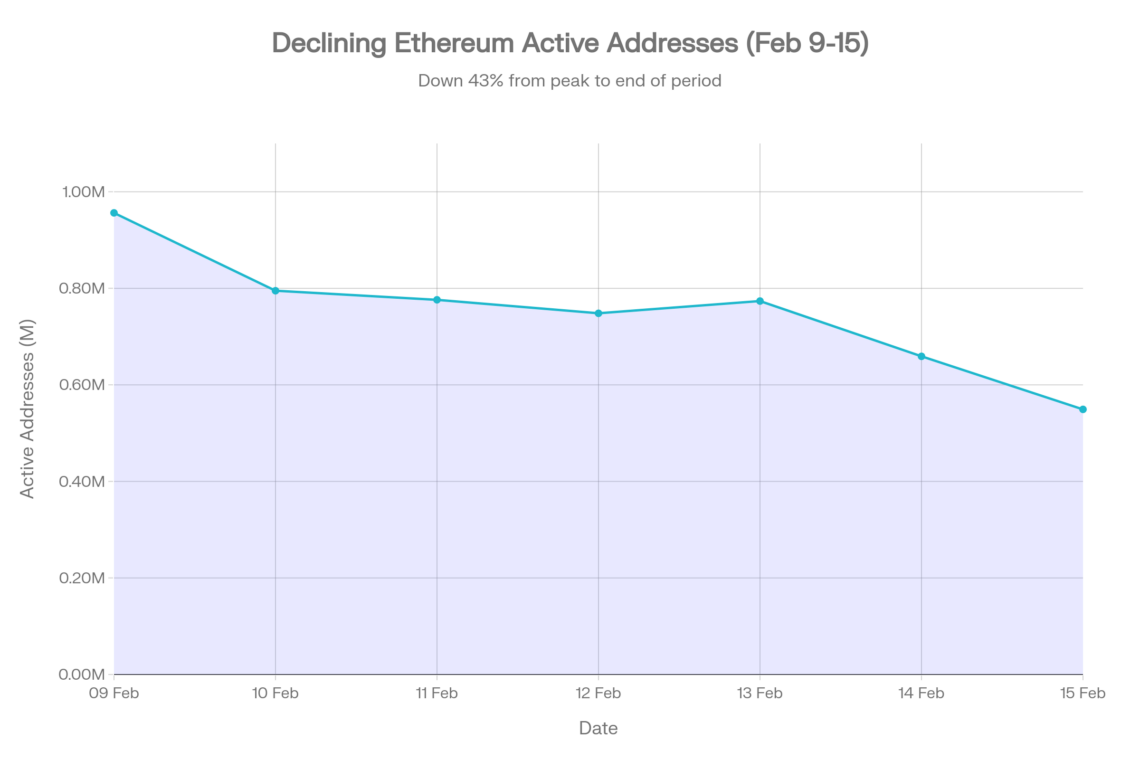
More concerning is the dramatic decline in active addresses, which plummeted from 956,198 on February 9 to just 549,188 by February 15 a staggering 42.5% drop. This significant reduction in user engagement suggests potential network congestion issues or users migrating to alternative chains with lower transaction costs.
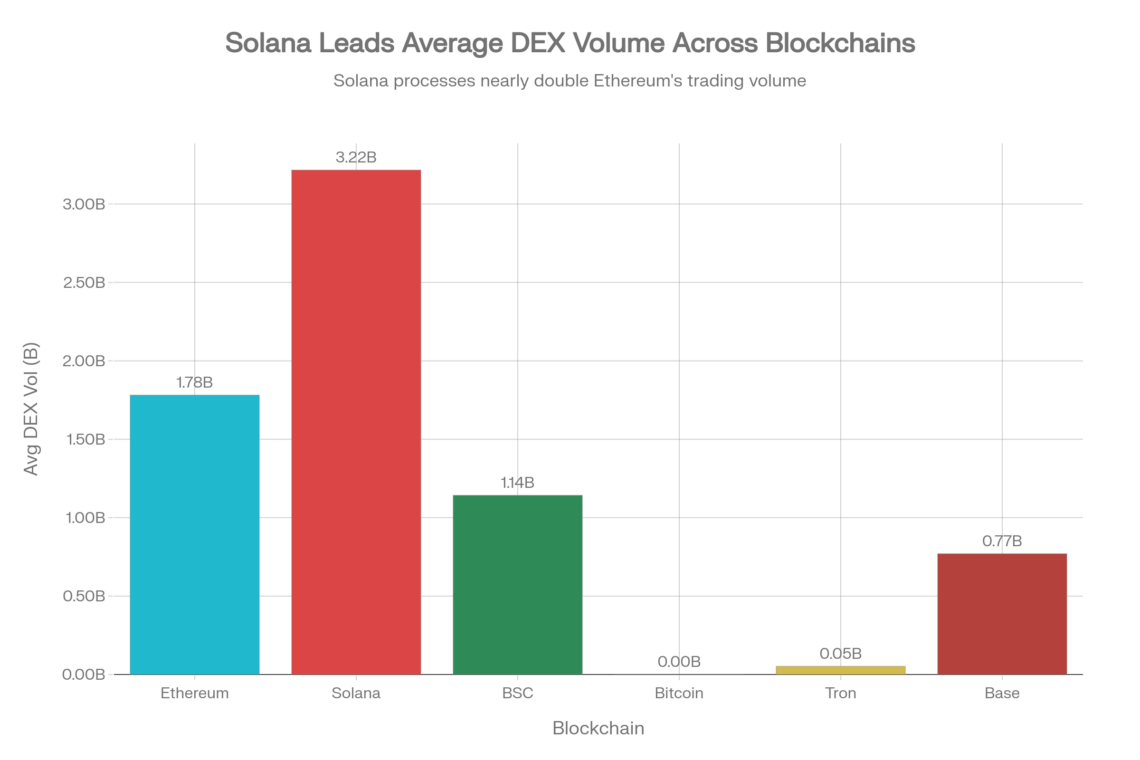
Despite these challenges, Ethereum’s DEX volume remained relatively stable, averaging $1.782 billion daily. The network saw a peak in DEX activity on February 11 with $2.202 billion in trading volume, though this subsequently declined to $1.629 billion by week’s end.
Chain fees showed considerable fluctuation, spiking to $676,156 on February 11 before dropping to $209,739 on February 14 the lowest point of the week. This volatility in fees correlates with network congestion and demand patterns.
Solana
Solana emerged as the clear winner in decentralized exchange activity, averaging an impressive $3.217 billion in daily DEX volume significantly outpacing all other networks analyzed. The network demonstrated consistent performance with TVL hovering around $6.45 billion throughout the week.
What sets Solana apart is its exceptional transaction throughput. The network processed between 74.26 million and 89.43 million transactions daily, dwarfing Ethereum’s 1.74-2.81 million transactions. This massive transaction capacity validates Solana’s positioning as a high-performance blockchain capable of supporting large-scale applications.
Solana’s active addresses remained robust, ranging from 2.12 million to 2.84 million daily users substantially higher than Ethereum despite having a fraction of the TVL. This suggests a more active and engaged user base utilizing the network for diverse applications beyond just value storage.
Chain fees remained consistently high, averaging around $665,000 daily, indicating strong network utilization and healthy validator economics.
BSC
Binance Smart Chain demonstrated remarkable stability throughout the week, with TVL gradually increasing from $5.546 billion to $5.766 billion. The network maintained steady performance across most metrics, though DEX volumes showed a notable decline, dropping from $1.448 billion on February 9 to $503.62 million by February 15.
BSC continues to attract significant user activity with 2.56-3.26 million active addresses daily, though this metric showed a declining trend. The network processed between 14.55 million and 17.53 million transactions daily, positioning it as a middle ground between Ethereum and Solana.
Chain fees averaged around $298,000 daily, representing a balanced approach between higher-fee Ethereum and low-fee competitors.
Bitcoin
Bitcoin’s role as a settlement layer and store of value network is evident in the metrics. With an average TVL of $5.17 billion and a market capitalization ranging from $1.323 trillion to $1.412 trillion, Bitcoin maintains its position as the most valuable cryptocurrency.
Active addresses remained relatively stable between 583,422 and 684,978, reflecting its primary use case as a value storage network. DEX volume was minimal, averaging just $1 million daily, as expected for a network not primarily designed for DeFi applications.
Tron
Tron’s standout metric is its stablecoin market capitalization, which consistently exceeded $84.7 billion the highest among all networks analyzed. This positions Tron as a critical infrastructure for global payments and remittances.
The network maintained steady TVL around $4.05 billion while processing 10.36-11.98 million transactions daily. Active addresses remained strong at 3.35-3.68 million daily users, demonstrating consistent network utilization.
Interestingly, Tron’s chain fees were the highest, averaging over $970,000 daily, indicating robust economic activity despite lower DEX volumes.
Base
As a relatively newer Layer-2 solution built on Ethereum, Base showed consistent performance with TVL around $3.9 billion. The network processed 9.76-11.99 million transactions daily with active addresses ranging from 332,232 to 468,334.
DEX volume averaged $770 million daily, positioning Base as a competitive alternative for traders seeking lower fees. Chain fees remained moderate, averaging around $144,000 daily, reflecting its mission to provide affordable transactions.
Cross-Chain Insights and Market Dynamics
The data reveals several critical insights. First, TVL dominance does not necessarily correlate with user activity or transaction volume. Ethereum holds 10x the TVL of Solana but processes a fraction of the transactions, suggesting different use cases.
Second, the emergence of high-performance chains like Solana challenges the narrative that networks must sacrifice decentralization for scalability.
Third, stablecoin distribution patterns show Ethereum hosting $158 billion in stablecoins, while Tron’s $85 billion stablecoin market cap relative to its $4 billion TVL highlights its role as a payments infrastructure, compared to the previous weekly Report Blockchain On-Chain Metrics: February 2–8, 2026.
Overall
The week of February 9-15, 2026, showcased a diverse and competitive blockchain ecosystem. Ethereum remains dominant in TVL but faces challenges in user retention and efficiency. Solana continues to demonstrate high performance, while BSC, Tron, and Base serve distinct strategic niches, based on DeFiLlama Data.
Disclaimer: Cryip's content is strictly for educational and informational purposes and does not constitute financial, legal, or investment advice. Cryptocurrency involves significant risk, and readers assume full responsibility for their own financial decisions. Asset references are never endorsements.
To make complex crypto topics accessible to readers at all experience levels, our team uses AI tools strictly to refine language, correct grammar, and simplify terminology. AI is never used to draft facts, source information, or form conclusions. Every article is fact-checked and approved by a human editor before publication. Read our full AI Use & Content Policy.