




DeFi portfolio tracking platform Zapper will shut down its operations on August 3, 2026, ending nearly seven years of service in the decentralized finance ecosystem. The closure will affect the company’s website, mobile applications, and API services.
“After close to 7 years building Zapper, I regret to announce that Zapper will be winding down. We evaluated a number of different options, pursued some to the fullest extent possible, and came to the realization that an orderly wind down is the best course of action.”
The announcement was made by co-founder and CEO Seb Audet, who said the company explored several alternatives before deciding that an orderly wind-down was the best path forward.
Zapper, headquartered in Montreal, Quebec, Canada, was founded in 2020 by Seb Audet and Suhail Gangji. The company was built as a remote-first startup during the COVID-19 pandemic and grew into one of the leading DeFi portfolio tracking platforms.
Zapper’s Seven-Year Journey Comes to an End
Founded during the early rise of decentralized finance, Zapper began as a personal portfolio tracker built by Audet while exploring DeFi. Over the years, it evolved into one of the industry’s most widely used dashboards, enabling users to monitor wallets, DeFi positions, NFTs, and on-chain assets across multiple blockchain networks.
According to Audet, Zapper grew to serve more than 2 million monthly active users and processed over $13 billion in transaction volume at its peak. Reflecting on the company’s journey, he described it as “the journey of a lifetime,” acknowledging both the successes and the challenges of building a crypto startup.
“I do believe we helped make the onchain economy significantly easier to use for a considerable number of people.”
Audet also thanked Zapper’s users, employees, investors, advisors, and community members for supporting the platform throughout its existence. He said the company’s mission was to make decentralized finance more accessible and believes it helped simplify the on-chain experience for millions of users.
Zapper Raised $16.6 Million From Major Crypto Investors
Zapper attracted strong backing during the DeFi boom, raising approximately $16.6 million across six funding rounds. Its largest financing came in May 2021, when the company secured a $15 million Series A led by Framework Ventures, with participation from Coinbase Ventures, Mark Cuban, Sound Ventures, ParaFi Capital, LongHash Ventures, Nascent, and Libertus Capital.
The funding was used to expand Zapper’s multi-chain portfolio tracking platform, improve the user experience for decentralized finance, and accelerate product development as DeFi adoption continued to grow. Despite support from major crypto investors and serving millions of users over nearly seven years, Zapper ultimately decided to wind down operations, underscoring the long-term sustainability challenges facing crypto infrastructure companies.
Services to End on August 3
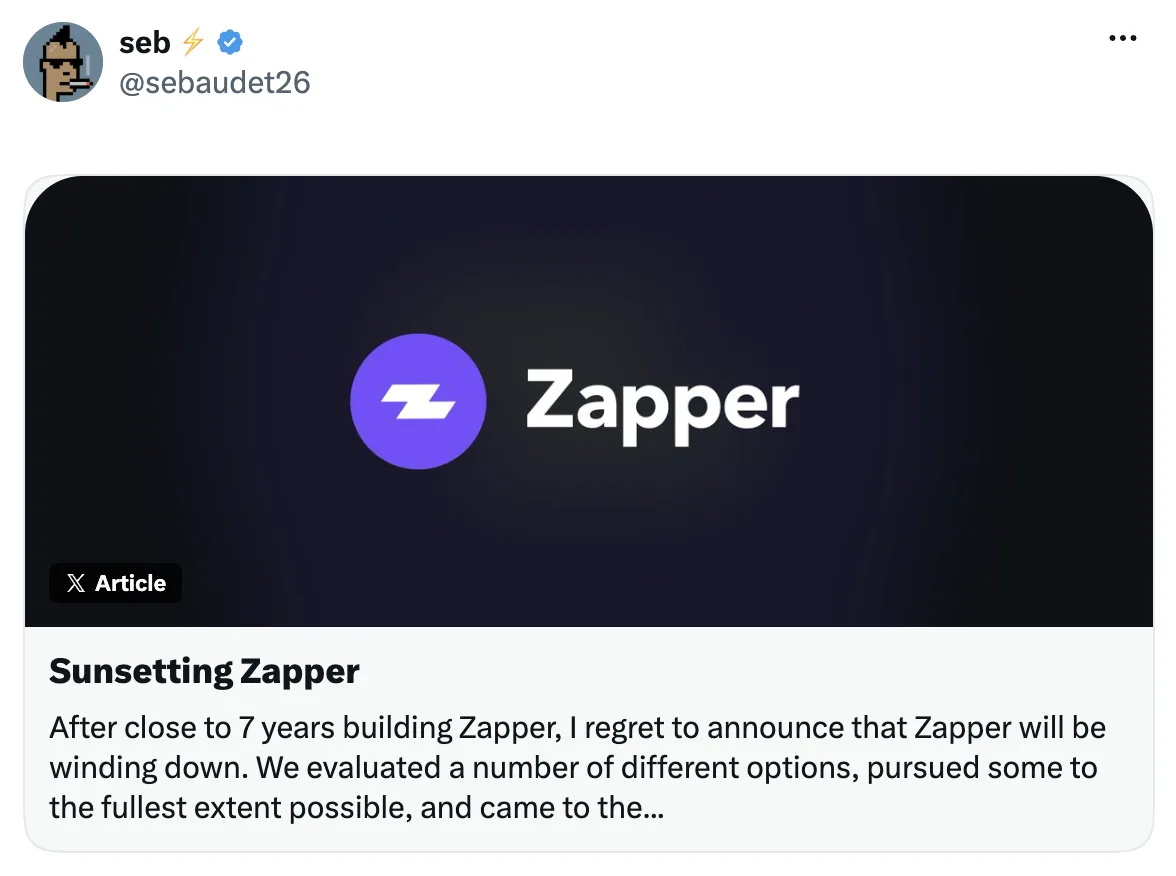
Zapper confirmed that all of its services, including zapper.xyz, its mobile applications, and API services, will permanently shut down on August 3, 2026. Existing API customers will receive transition emails with guidance on migrating their integrations before the shutdown.
In his announcement, Audet also encouraged companies across the crypto and technology sectors to consider hiring Zapper’s team. He highlighted their experience in scaling a platform used by millions of people and processing more than $13 billion in transaction volume, describing them as a team with deep expertise in on-chain engineering and operational infrastructure.
The closure marks the end of one of DeFi’s longest-running portfolio management platforms and reflects the challenges facing crypto infrastructure companies as the industry continues to evolve.
Earlier this year, DeFi superapp Legend shut down after struggling to sustain long-term growth, marking the end of its Web3 journey. More recently, the AscendEX shutdown has come under fresh scrutiny as users reported withdrawal delays during the platform’s wind-down process. The closures highlight the operational and financial challenges that continue to confront crypto platforms despite ongoing innovation across the digital asset industry.
Disclaimer: Cryip's content is strictly for educational and informational purposes and does not constitute financial, legal, or investment advice. Cryptocurrency involves significant risk, and readers assume full responsibility for their own financial decisions. Asset references are never endorsements.
To make complex crypto topics accessible to readers at all experience levels, our team uses AI tools strictly to refine language, correct grammar, and simplify terminology. AI is never used to draft facts, source information, or form conclusions. Every article is fact-checked and approved by a human editor before publication. Read our full AI Use & Content Policy.