



Zcash’s native token ZEC drew fresh market attention after Project Tachyon said its formal verification work for Ironwood is moving closer to proving that the new shielded pool does not contain undetectable counterfeiting bugs.
The update comes after Zcash’s Orchard shielded pool faced a serious vulnerability that raised concern over supply verification. While the bug was patched, the private nature of shielded transactions made it difficult to fully prove from public chain data whether counterfeit coins had ever been created.
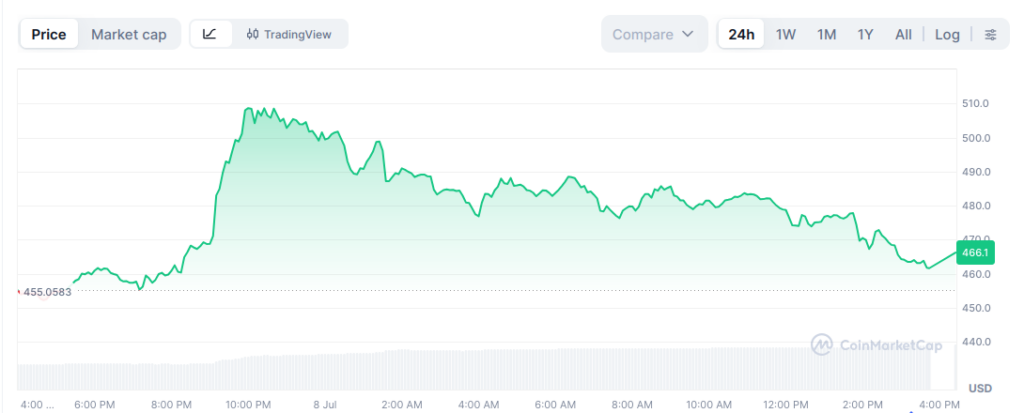
Market data showed ZEC regaining the $500 level during the rally. CoinMarketCap’s ZEC update said the token surged more than 10% on July 7, 2026, to reclaim $500, breaking a key resistance level after weeks of consolidation. CoinMarketCap’s live page later showed ZEC trading near $466.53, with about $715.03 million in 24-hour volume, while its price analysis section showed ZEC up 8.48% to $485.91 on July 8, 2026, driven mainly by progress on Ironwood’s formal verification.
Orchard Bug Raised Supply Concerns
The rally comes after Zcash moved past a difficult Orchard upgrade period that tested both market confidence and network infrastructure. Following the emergency fix, several public block explorers briefly showed no new blocks for more than four hours, creating the impression of a network halt, although later clarification said the core blockchain continued operating normally.
The earlier disclosure had also triggered strong selling pressure as traders reacted to the possibility of undetectable counterfeit coins inside the shielded pool. Although researchers said there was no evidence of live exploitation, the incident left supply integrity as the main concern for the market.
The visibility issue was linked to some explorers and wallets syncing with outdated or stale nodes after the upgrade, rather than a fundamental consensus failure. Node operators were later urged to upgrade to Zebra 5.0.0 for full network compatibility.
- Orchard had a counterfeiting-related vulnerability.
- The bug was patched through a network upgrade.
- Shielded privacy made historical verification difficult.
- Zcash needed a stronger way to prove supply integrity.
Ironwood Aims to Restore Verification
Ironwood is Zcash’s planned new shielded pool. The Zcash Community Forum says its objective is to restore each user’s ability to verify Zcash supply integrity by running a node. The security debate also came after an earlier Orchard upgrade caused several public block explorers to briefly show no new blocks, even though later clarification indicated the core Zcash blockchain continued operating normally.
The upgrade creates a new shielded pool using the corrected Orchard design. It also introduces a transition process that helps place a clear boundary around the older Orchard pool. This is meant to reduce uncertainty and make the circulating supply easier to verify without removing Zcash’s privacy features. In simple terms, Ironwood is not just a normal upgrade. It is a trust-rebuilding step after a major shielded-pool security scare.
Formal Verification Drives Market Confidence
Project Tachyon said its team is working to formally verify Ironwood and rule out undetectable counterfeiting bugs. Formal verification is stronger than a normal audit because it aims to mathematically prove that the system follows its intended rules.
The incident also underlined how AI-assisted security research is becoming more important in crypto, after the Orchard flaw was identified during an advanced audit process that pushed Zcash toward deeper verification work.
That is the main reason the update became bullish for ZEC. Traders are not only reacting to price momentum; they are reacting to the possibility that Zcash may soon have stronger mathematical assurance for its new shielded pool.
Still, Ironwood’s real impact depends on successful activation, wallet support, user migration, and continued security review. For now, Zcash is trying to show that privacy and supply verification can work together without weakening the core shielded transaction model.
Disclaimer: Cryip's content is strictly for educational and informational purposes and does not constitute financial, legal, or investment advice. Cryptocurrency involves significant risk, and readers assume full responsibility for their own financial decisions. Asset references are never endorsements.
To make complex crypto topics accessible to readers at all experience levels, our team uses AI tools strictly to refine language, correct grammar, and simplify terminology. AI is never used to draft facts, source information, or form conclusions. Every article is fact-checked and approved by a human editor before publication. Read our full AI Use & Content Policy.