


South Korean authorities have launched the country’s first formal police investigation targeting domestic users of Polymarket, the leading decentralized prediction market platform. This marks a notable escalation in regulatory oversight of crypto based betting activities.
According to a report by Chosun Biz, the Gangwon Provincial Police Agency, at the request of the Korean National Police Agency, is examining users nationwide who participated in Polymarket markets related to the June 3 local elections. Reports indicate that betting volumes on these election related contracts reached hundreds of billions of won (tens of millions of USD). The activity was facilitated by the platform’s use of stablecoins and relatively open access for Korean residents.
Under South Korean law, gambling outside the government sanctioned Sports Toto system is strictly prohibited. Participants in such activities risk fines of up to 10 million won (approximately $7,200) under Article 246 of the Criminal Act. Legal observers describe the case as unprecedented, as no prior enforcement actions have specifically targeted Polymarket users in the country.
Attorney An Chang bo, representing some of the individuals under investigation, told reporters that while the elements of a gambling offense may be present, the lack of precedent makes it challenging to forecast the severity of potential penalties. Notably, the Korea Communications Standards Commission has not yet moved to block access to the platform, citing an absence of formal complaints.
Polymarket’s Rise and the Regulatory Clash
Polymarket has experienced explosive growth in recent years, positioning itself as a sophisticated information market rather than traditional gambling. The platform allows users to trade on real world event outcomes from politics and crypto prices to sports and global affairs using blockchain technology and stablecoin collateral. Its markets have often demonstrated higher accuracy than conventional polling in major events.
In recent developments, Polymarket executed its first institutional block trade earlier this week. This signals growing interest from larger players. However, the platform is also facing controversy after a trader claimed a roughly $500,000 loss on a high stakes contract involving Strategy’s Bitcoin sales. The dispute over market resolution has now moved to token holder voting.
This latest probe in South Korea comes amid broader global scrutiny. Industry watchers note that while Polymarket operates legally in several U.S. states, its model collides with Korea’s tightly controlled betting ecosystem.
This latest probe in South Korea comes amid broader global scrutiny. Industry watchers note that while Polymarket operates legally in several U.S. states, its model collides with Korea’s tightly controlled betting ecosystem. The platform is also facing growing pressure to strengthen KYC requirements amid rising global compliance risks, including sanctions enforcement and geoblocking challenges.
Emerging Challenges in Prediction Market Integrity
Adding to these regulatory concerns, a high profile case in the United States has drawn fresh attention to potential misuse of non public information on the platform. Federal prosecutors have accused a Google software engineer of using confidential internal search data to win approximately $1.2 million through strategic bets on Polymarket markets tied to Google’s “Year in Search” rankings. The case has sparked debate over insider trading rules in decentralized prediction markets.
Bitcoin Market Context Amid Regulatory Developments
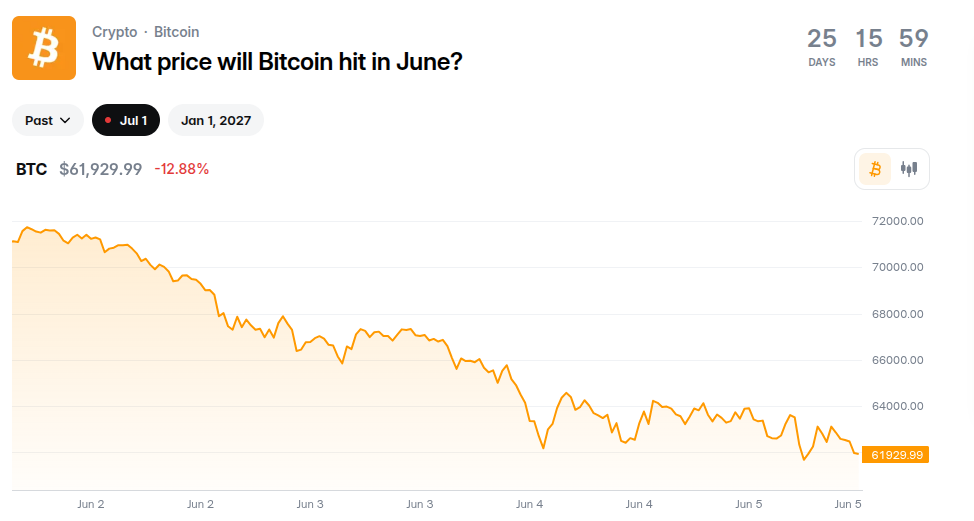
The investigation arrives at a time of cautious sentiment in cryptocurrency markets. As of June 5, 2026, Bitcoin (BTC) is trading in the $62,000 $63,500 range. This reflects consolidation after pulling back from recent highs near $73,000 in late May. Factors contributing to the pressure include sustained ETF outflows, macroeconomic uncertainty, and regional regulatory headlines.
Key Market Observations (as of latest data):
- Short term Polymarket contracts on Bitcoin price bands suggest traders are pricing in range bound movement rather than immediate breakout in early June.
- Broader 2026 outlook remains divided. Some participants anticipate recovery driven by institutional adoption, while others flag downside risks from regulatory tightening in key markets like South Korea.
- Trading volumes on Polymarket’s own BTC related markets remain elevated. This underscores the platform’s influence as both a betting venue and sentiment gauge.
This regulatory development could contribute to short term negative sentiment in Asian crypto circles. However, global liquidity and long term adoption trends provide counterbalancing support.
Implications for Prediction Markets
The South Korean case raises broader questions about the classification of decentralized prediction platforms. Supporters argue they function primarily as information aggregators that harness collective intelligence. Critics and regulators, however, view them through the lens of traditional gambling when real financial stakes are involved.
As prediction markets mature and attract mainstream and institutional interest, clashes with legacy regulatory frameworks appear likely to intensify. For now, South Korean users are receiving a clear signal that authorities are monitoring cross border crypto activities more closely. This comes as South Korean prosecutors have also launched the country’s first criminal crackdown on a DEX rug pull scheme involving the Solana-based meme coin CATFI, where five suspects were indicted for alleged market manipulation that caused investor losses of around 900 million won.
Industry participants and legal experts will be watching the outcome of this probe closely, as it could set a precedent for enforcement across other jurisdictions in the region.
Disclaimer: Cryip's content is strictly for educational and informational purposes and does not constitute financial, legal, or investment advice. Cryptocurrency involves significant risk, and readers assume full responsibility for their own financial decisions. Asset references are never endorsements.
To make complex crypto topics accessible to readers at all experience levels, our team uses AI tools strictly to refine language, correct grammar, and simplify terminology. AI is never used to draft facts, source information, or form conclusions. Every article is fact-checked and approved by a human editor before publication. Read our full AI Use & Content Policy.